Engineering
Lead screw and screw jack
Lift the same load with screws of one, two and four starts and compare torque and efficiency; then switch the motor off and lower the friction until the load turns the screw back.
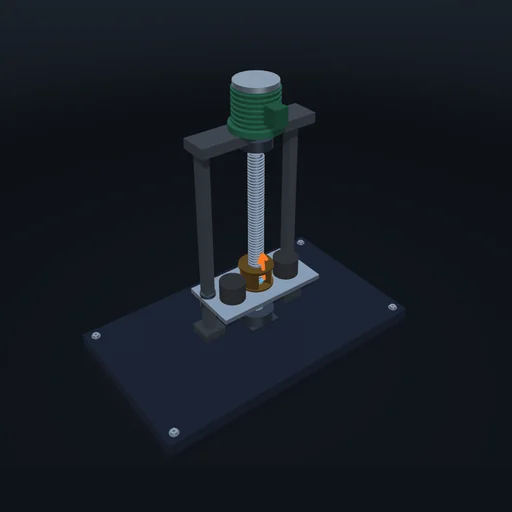
What happens
A motor turns a vertical screw of mean radius 70 mm; its nut lifts a platform with the load along a guide. One, two or four thread starts on a 30 mm pitch give a lead L of 30, 60 or 120 mm per turn and the lead angle tan λ = L/(2πr): 3.9°, 7.8° or 15.3°. The flank slides with Coulomb friction, φ = atan μ. Lifting the weight W takes T = W·r·tan(λ + φ), and only tan λ/tan(λ + φ) of the motor’s work becomes height: 36 % for one start, 67 % for four with μ = 0.12. Lowering takes T = W·r·tan(φ − λ): positive while λ < φ, so the motor has to drive the load down – the screw locks itself, and switched off it holds any load. With λ > φ the torque turns negative: the load runs the screw back, and the motor has to brake it. At μ = 0.12 only the single-start screw holds; at μ = 0.15 the double one holds too. A self-locking screw never reaches 50 % efficiency.
Model: rigid screw, nut and platform; the thread is one flank contact with Coulomb friction that sticks or slides. No thrust-bearing or guide friction, no elasticity; μ does not depend on speed or load.
Try this
Lift with each lead and compare torque and efficiency; then switch the motor off and lower μ until the load runs down.
Equations used in the module
Equations
tan λ = L/(2πr),  φ = atan μ
T↑ = W r tan(λ + φ)
T↓ = W r tan(φ − λ)
η = tan λ / tan(λ + φ)
λ ≤ φ  ⇒  T↓ ≥ 0,  η < ½