Engineering
Ball screw actuator
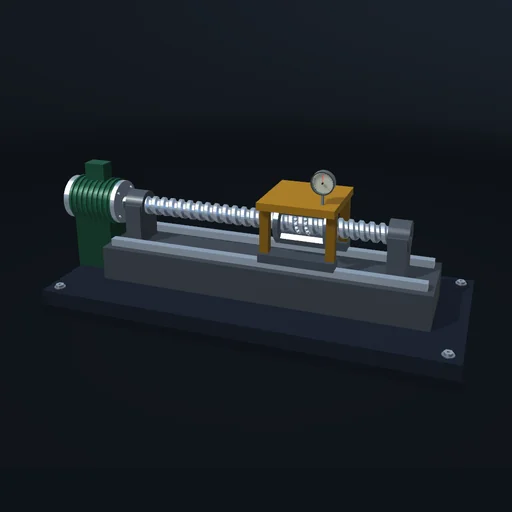
Move the carriage between two stations with a preloaded nut and with a nut that has play, and watch how far it lags the motor. Push the standing carriage to measure the nut’s stiffness, then switch the servo off and push again: the screw turns back.
What happens
A servo motor turns a ball screw, and its nut carries a carriage along a guide between two stations 1 m apart. The servo knows only the motor’s angle, so the carriage stands where the screw puts it plus whatever the nut gives. The nut is two halves of balls, each an axial spring of stiffness k. Preloaded against each other with Fp, both halves carry: a push F moves the carriage F/(2k), without any play, until at F = 2Fp one half unloads and the stiffness halves. Without preload the nut has play: a reversing push first crosses the gap, then one half takes the load, F/k. The error reading shows how far the carriage is ahead of the motor, in micrometres. Rolling balls lose little: tan λ/tan(λ + φ) is over 97 %, so with the servo off a push on the carriage spins the screw back. The preload costs a constant drag torque.
Model: rigid screw and carriage; each nut half is an elastic flank contact with rolling friction μ = 0.005, preload, play and stiffness set per half; the servo is a speed loop on the motor’s angle. No ball dynamics, no torsion or bending of the screw, no thermal growth.
Try this
Press Move with each nut and compare the error; then push the standing carriage, and switch the servo off before you push again.
Equations used in the module
Equations
x = L·θ/(2π)
F < 2Fp:  δ = F/(2k)
F > 2Fp:  δ = (F − Fp)/k
η = tan λ / tan(λ + φ)
Tp = 2μFp r / cos²λ