Engineering
Chain and sprockets
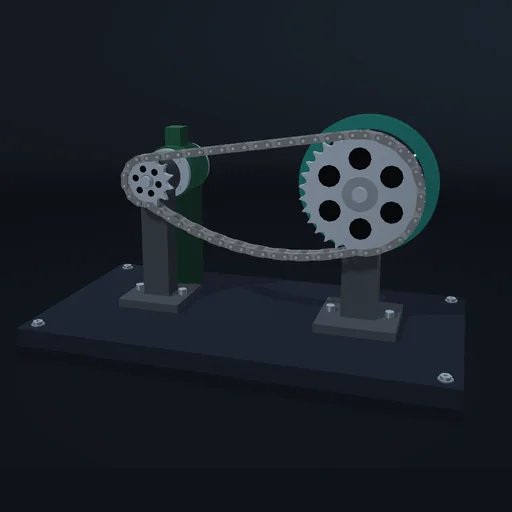
Drive a sprocket of 30 teeth through a roller chain from one of 9, 13 or 19 teeth and watch the driven speed ripple once per tooth. Then give the chain some slack and start again: the motor runs ahead until the run snaps tight.
What happens
A roller chain of 80 mm pitch runs from a small driving sprocket to one of 30 teeth that carries a flywheel and a load brake. A chain does not wrap a sprocket’s pitch circle but its pitch polygon: the tight run leaves from the corner where the last roller is seated, and as the sprocket turns through one tooth, the run’s line rises and falls. So the driven sprocket follows the driver at z₁/z₂ only on average, and its speed ripples once per tooth – the chordal effect. Few teeth make it worse: with 9 teeth the ratio swings by about 7 %, with 19 by under 2 %. The tight run carries the load torque over the driven pitch radius; the slack run carries nothing. Give the chain some slack: at the start the motor turns freely until the run comes tight, and then the run jerks the flywheel with a peak of tension.
Model: rigid sprockets; each free run is a straight, massless, elastic span between its end rollers that pulls but never pushes, and rollers seat and leave one by one. No sag, link mass or roller impact; the slack run is drawn hanging.
Try this
Compare the ripple with 9, 13 and 19 teeth; then add slack, start again and watch the peak tension.
Equations used in the module
Equations
R = p / (2 sin(π/z))
ω₂/ω₁ ≈ z₁/z₂
Δω/ω ≈ 1 − cos(π/z₁)
F = T₂/R₂