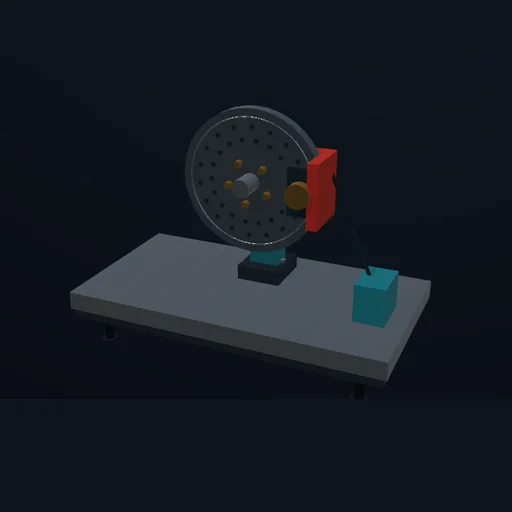
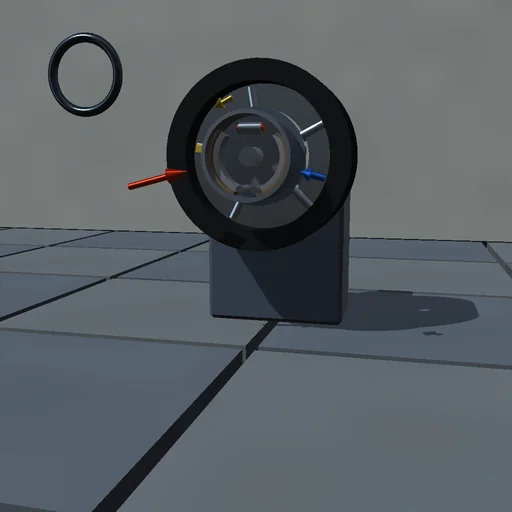
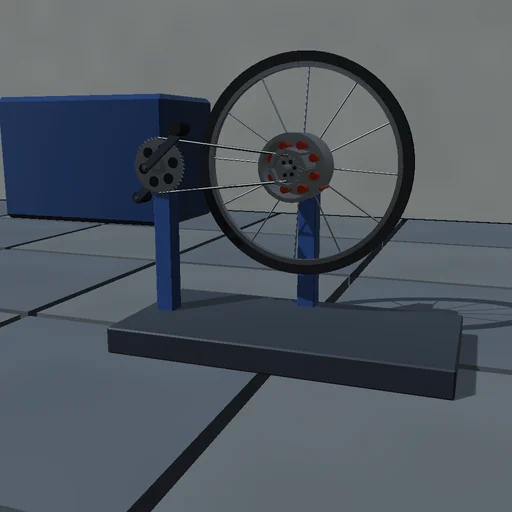
Engineering
Dog clutch and synchronizer
Shift the sleeve at different speed differences and phases: dogs over gaps slide in, dogs on dogs clash and bounce, and a flank hit locks the shafts with a jolt that conserves angular momentum and turns the rest into heat. Switch on the synchronizer: the cone clutch drags the speeds together while the baulk ring blocks the sleeve, then the chamfers index the teeth and the dogs go in without a clash.
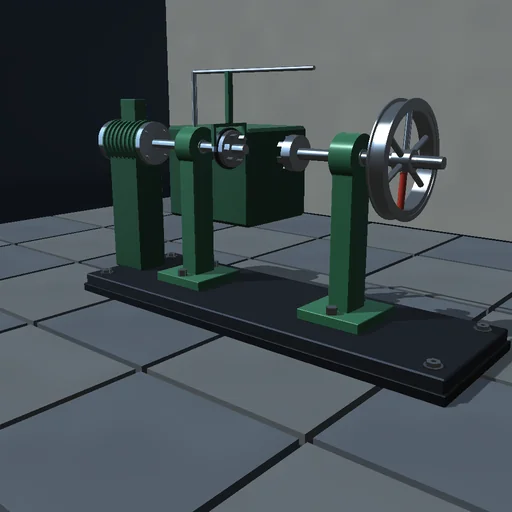
What happens
A sliding sleeve of six dogs on the input shaft is pushed towards a hub of six dogs on the output shaft. At the face the relative phase decides: dogs over gaps (within the window (1 − 2w)·p/2 about the gap’s centre) slide in; dogs on dogs bounce off with a restitution of 0.3 - a clash. While sliding in the relative angle drifts, and when a dog meets a flank the shafts lock impulsively: angular momentum is conserved, the rest of the energy is booked as heat ½·J_1J_2/(J_1 + J_2)·Δω². The synchronizer puts a cone clutch of torque μ·F·R/sin α between the shafts and a baulk ring that holds the sleeve until the speeds are within 0.5 rad/s, then the chamfers index the hub into alignment. Semi-implicit Euler at 0.1 ms.
Try this
Shift at 300 against 100 rpm and count the clashes before the lock; set the output to the input speed and the phase to a gap and the dogs slide in; switch the synchronizer on and shift again.
The model and its limits
Dogs as rigid angular sectors without chamfer geometry beyond the indexing rule, an impulsive lock without flank compliance, a constant cone friction. Clash counts are those of this idealized sleeve.
Equations used in the module
Equations
p = 2π/z,  |ψ − p/2| ≤ (1 − 2w)·p/2
ω = (J_1·ω_1 + J_2·ω_2)/(J_1 + J_2)
Q = ½·J_1·J_2/(J_1 + J_2)·(ω_1 − ω_2)²
T_c = μ·F·R_c/sin α