Engineering
Drum brake and self-energizing
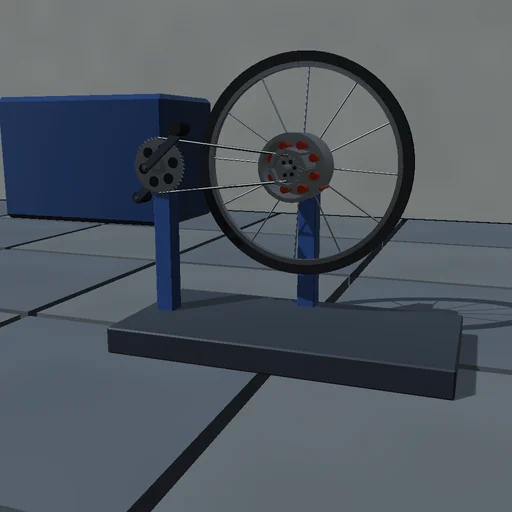
Brake a wheel from 72 km/h and read the two shoes’ normal forces: the leading shoe presses itself on with the friction and carries most of the torque; without friction the amplification vanishes, and when mu reaches c/b the shoe self-locks. Reverse the drum on a twin-leading brake and lose most of the torque; then hold a descent for minutes and watch the drum heat, the lining fade and the vehicle run away.
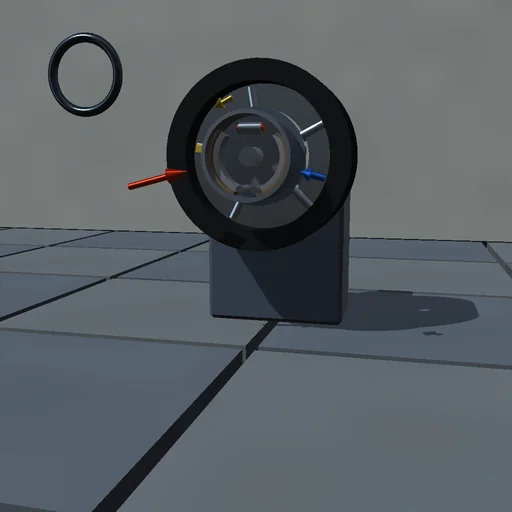
What happens
Two shoes pivoted at the bottom of a backplate are pressed into the drum by one wheel cylinder. The moment balance of a shoe about its pivot, F·a ± μ·N·b = N·c, gives the leading shoe N = F·a/(c − μ·b) and the trailing one N = F·a/(c + μ·b): the friction presses the leading shoe on - self-energizing - and locks it when μ·b reaches c. A simplex brake keeps its torque in both directions; a twin-leading brake has both shoes leading forwards and both trailing in reverse. The drum stops a 300 kg share of a vehicle through a 0.3 m wheel, or holds it on a descent: friction heats an 8 kg drum, convection cools it, and above 150 °C the lining fades linearly to half its friction, so a long descent runs away.
Try this
Read the leading and trailing normal forces at the same cylinder force, then set the friction to zero and above c/b. Try the twin-leading layout in reverse, and hold the descent for three minutes.
The model and its limits
Short-shoe statics with constant lever arms, friction independent of speed except for the thermal fade, a lumped drum temperature, no tyre slip. Not a brake rating.
Equations used in the module
Equations
N_lead = F·a/(c − μ·b),  N_trail = F·a/(c + μ·b)
T = μ·(N_lead + N_trail)·R,  μ_lock = c/b
J·dω/dt = T_g − T,  s = v_0²/(2a)
m_d·c_p·dΘ/dt = T·ω − h·(Θ − Θ_0)