Engineering
Overrunning clutch
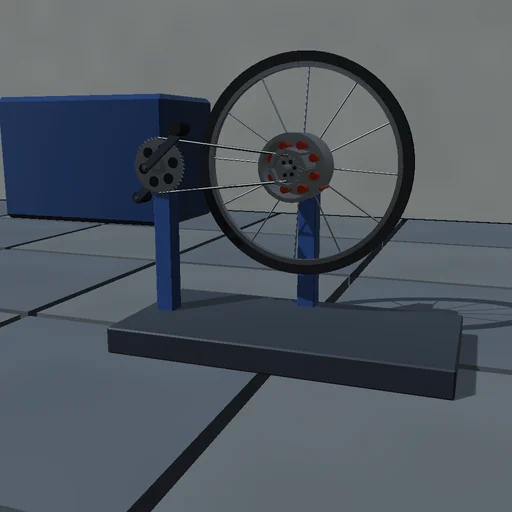
Pedal a wheel through a roller freewheel: the rollers take up their backlash, wedge with a jolt that is booked as lost energy, and drive; stop pedalling and the wheel coasts against its load while the rollers roll free with no torque in that direction; pedal faster than the wheel again and time the take-up; open the wedge angle beyond what the friction can hold and the rollers skid.
What happens
A bicycle’s rear hub: the cranks drive the inner race with its ramps, rollers lie between the ramps and the outer race, and the outer race carries the wheel. When the input runs ahead the rollers roll up their ramps through the backlash β and wedge - the wheel takes the input speed at once, and the energy ½·J·Δω² that does not fit is lost in the rollers; then the clutch drives rigidly while the torque the wheel asks for is positive. When the input slows the rollers roll back and the wheel coasts against its drag and rolling resistance. Rollers on ramps of wedge angle α hold only while tan(α/2) is at most the friction coefficient; steeper ramps skid. Semi-implicit Euler at 0.1 ms with a stick state for the rolling resistance.
Try this
Pedal, then stop and watch the wheel coast on while the torque reads zero; pedal faster than the wheel and read the take-up time; open the wedge past the friction and nothing is transmitted.
The model and its limits
An ideal one-way coupling with inelastic wedging and a constant backlash; no roller elasticity, no spring-loaded rollers, no drag torque in the driving direction beyond a viscous term. A teaching freewheel.
Equations used in the module
Equations
tan(α/2) ≤ μ
t_takeup = β/(ω_in − ω_out)
Q = ½·J·(ω_in − ω_out)²
J·dω_out/dt = T − b·ω_out − T_r