MakarovSuites
English
EnglishDeutschРусскийУкраїнськаFrançaisEspañolItalianoPolski
Contact & licences

Engineering

External gear pump

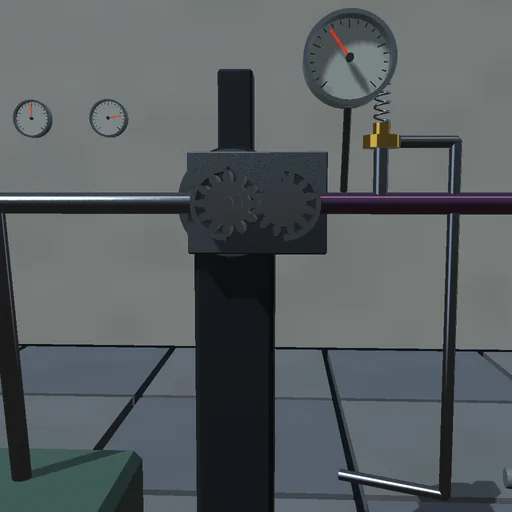
Run a gear pump into a load valve and close the valve: the pressure, the slip leakage and the motor’s torque rise together until the relief valve lifts and the motor slows on its torque line. Open the gears’ clearance and watch the volumetric efficiency fall at the same drive; without leakage the mean flow is exactly the displacement times the speed. The shaft’s work is booked against the useful flow, the leak, the relief and the friction.
External gear pump — Actual application image
Actual application image

What happens

A 10 cm³/rev gear pump on a motor with a straight torque-speed line (20 N·m stall, 300 rad/s no load) feeds a 0.2 L line with a load orifice and a relief valve. The gears deliver V_d·ω/2π; laminar slip through the clearances takes G·δ³·p/μ back; the relief poppet opens between 100 and 110 bar through a 5 ms lag; the line’s pressure follows the oil’s bulk modulus. The pump asks V_d·p/2π plus Coulomb and viscous friction from the shaft, so closing the valve raises the torque and slows the motor on its line. RK4 at 10 µs; the shaft’s work is found again in the flow’s work, the leak, the relief, the friction and the oil stored in the line.

Try this

Close the load valve slowly and watch the pressure, the leakage and the torque rise until the relief valve lifts; open the clearance to 60 µm and read the volumetric efficiency; set it to zero and the flow is the displacement times the speed.

The model and its limits

Lumped line volume, laminar slip leakage with a geometric constant, turbulent orifices with a constant coefficient, no flow ripple or trapped-volume effects, a motor without thermal limits.

Equations used in the module
Equations
Q_th = V_d·ω/(2π),  Q_leak = G·δ³·p/μ
dp/dt = β/V·(Q_th − Q_leak − Q_out − Q_relief)
T = V_d·p/(2π) + T_f + c·ω,  T_m = T_s·(1 − ω/ω_0)
η_v = 1 − Q_leak/Q_th,  η_m = V_d·p/(2π·T)
Related experiments

Back to catalogue
Axial piston pump — Actual application image

Engineering

Axial piston pump

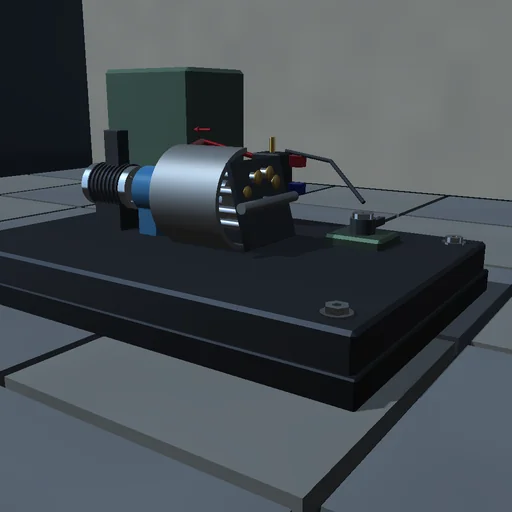
Tilt the swash plate of a nine-piston pump and watch line A fill to the pressure the load orifice demands: the displacement follows tan of the swash angle, reversing it sends the flow round the other way, zero swash leaves the motor idling at its no-load speed. Count the flow ripple of nine pistons and compare it with the closed form, block the load and let the relief valve take the whole flow, lower the charge pressure and see the return line starve. Shaft and charge work are booked against the pressure energy in the lines and the losses in the orifice, the leaks and the relief.

Centrifugal pump — Actual application image

Engineering

Centrifugal pump

Run a centrifugal pump into a pipe that lifts water ten metres: the flow settles where the pump curve H = K1 w^2 - K2 w Q - K3 Q|Q| crosses the system curve Hs + R Q|Q|, exactly the closed-form root. Throttle the discharge valve and watch the point climb the pump curve at less flow and more head; slow the motor and compare with the affinity laws, which hold only when the static head is taken away; drop below the speed whose shutoff head equals the lift and the flow stops. The motor’s work is booked against the lift, the pipe and internal losses, the disk friction and the kinetic energy of wheel and water.

Hydraulic motor — Actual application image

Engineering

Hydraulic motor

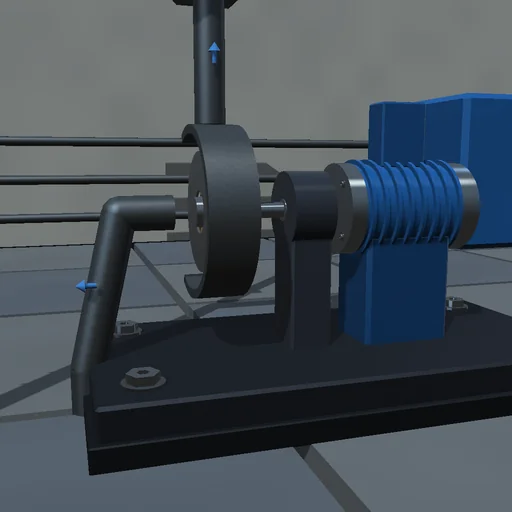
Feed a fixed-displacement motor from a 150 bar line through an inlet orifice and let it drain through another: free, it settles where the two throttles and friction use up the supply pressure, the closed-form speed of that balance. Load the brake and read the pressure difference climb as D dp / 2 pi meets brake plus friction; load it past the supply’s torque and it stalls. Drive the shaft from outside and the machine turns into a pump, lifting the outlet above the inlet; drive it faster than the inlet can feed and the inlet line drains to vapour pressure, the shortfall booked as cavitation. Supply and external work are booked against the throttling, the leaks, the heat and the stored energy.