MakarovSuites
English
EnglishDeutschРусскийУкраїнськаFrançaisEspañolItalianoPolski
Contact & licences

Engineering

Centrifugal pump

Run a centrifugal pump into a pipe that lifts water ten metres: the flow settles where the pump curve H = K1 w^2 - K2 w Q - K3 Q|Q| crosses the system curve Hs + R Q|Q|, exactly the closed-form root. Throttle the discharge valve and watch the point climb the pump curve at less flow and more head; slow the motor and compare with the affinity laws, which hold only when the static head is taken away; drop below the speed whose shutoff head equals the lift and the flow stops. The motor’s work is booked against the lift, the pipe and internal losses, the disk friction and the kinetic energy of wheel and water.
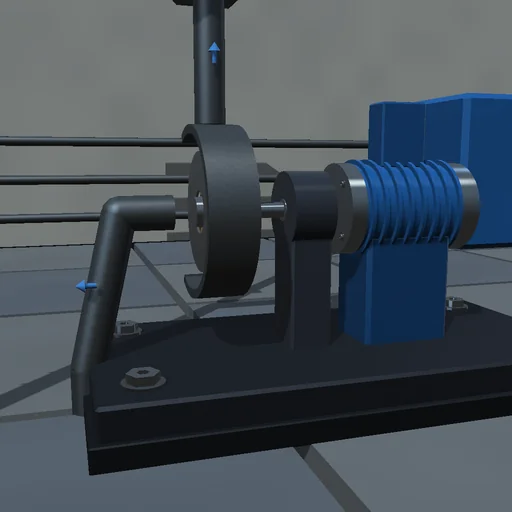
Centrifugal pump — Actual application image
Actual application image

What happens

A motor ramps a centrifugal pump to its set speed; the water in a 50 m pipe of 0.01 m² accelerates by dQ/dt = (g·A/L)·(H − H_sys) until the pump’s head K_1·ω² − K_2·ω·Q − K_3·Q|Q| meets the static lift plus the pipe and valve losses, the closed-form root of the two curves. The hydraulic torque is ρ·g·Q·(K_1·ω − K_2·Q), disk friction and a constant torque are the shaft losses, and the valve’s resistance grows as 1/opening². Each millisecond books the motor’s work against the lift, the losses and the kinetic energy of wheel and water, so the ledger closes to rounding; without static head the operating points at two speeds are homologous and the affinity laws hold exactly.

Try this

Let the flow settle and compare it with the closed-form crossing; throttle the valve and read the head climb; slow the motor with and without static head and check the affinity laws.

The model and its limits

A quadratic pump curve and a quadratic system curve, a rigid water column in a straight pipe, no cavitation or NPSH, a drive that holds its set speed. Not a selection of a real pump.

Equations used in the module
Equations
H = K_1·ω² − K_2·ω·Q − K_3·Q·|Q|,  H_sys = H_s + (R_p + R_v/x²)·Q·|Q|
dQ/dt = (g·A/L)·(H − H_sys),  T_h = ρ·g·Q·(K_1·ω − K_2·Q)
Q_2/Q_1 = ω_2/ω_1,  H_2/H_1 = (ω_2/ω_1)²  (H_s = 0)
W_motor = E_k + ρ·g·H_s·V + Q_pipe + Q_int + Q_fr
Related experiments

Back to catalogue
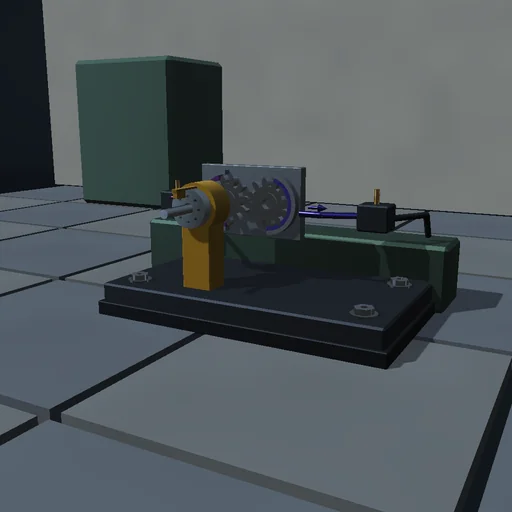
Hydraulic motor — Actual application image

Engineering

Hydraulic motor

Feed a fixed-displacement motor from a 150 bar line through an inlet orifice and let it drain through another: free, it settles where the two throttles and friction use up the supply pressure, the closed-form speed of that balance. Load the brake and read the pressure difference climb as D dp / 2 pi meets brake plus friction; load it past the supply’s torque and it stalls. Drive the shaft from outside and the machine turns into a pump, lifting the outlet above the inlet; drive it faster than the inlet can feed and the inlet line drains to vapour pressure, the shortfall booked as cavitation. Supply and external work are booked against the throttling, the leaks, the heat and the stored energy.

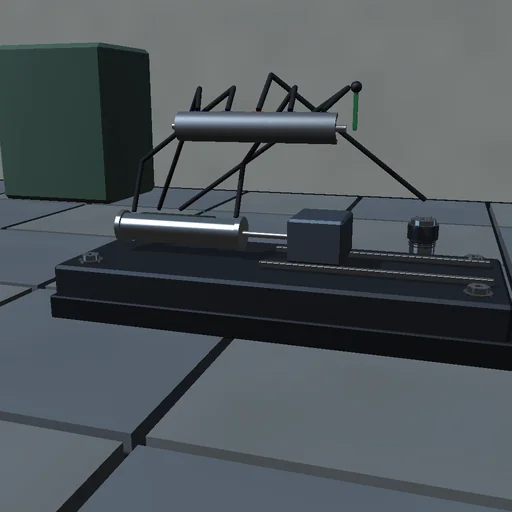
Valve-controlled actuator — Actual application image

Engineering

Valve-controlled actuator

Move the command of a four-way spool and watch the slide follow: with a closed-centre spool nothing happens inside the lap, then the speed lands on the quasi-static balance of the two metering orifices and friction, and at null the load is held tight. Switch to an open-centre spool and the valve leaks 2 Cd w u sqrt(ps/rho) at null while both chambers sit at half the supply, but the smallest command tilts the pressures steeply towards the load. Push against the slide and read the pressure difference it needs. The supply’s pQ is booked against the throttling, the load’s Fv, the friction and the oil’s compression.

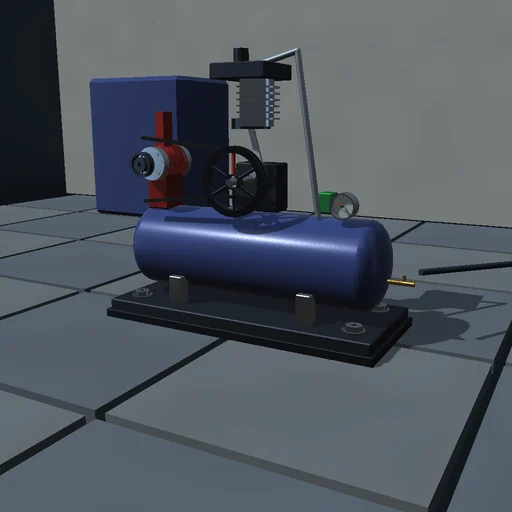
Air compressor — Actual application image

Engineering

Air compressor

Start a single-cylinder compressor on a ten-litre receiver and watch the gauge climb: each stroke draws air through the intake plate, squeezes it hot and pushes it past the delivery plate once the cylinder beats the tank. The mass delivered per cycle shrinks as the tank fills, close to the clearance-volume closed form 1 - c ((p/p0)^(1/n) - 1); a larger clearance delivers less. At the set pressure the switch stops the motor, the unloader vents the cylinder and the machine coasts to rest; open the consumer and the tank settles where delivery meets the bleed. Motor work and intake enthalpy are booked against the gas’s internal energy, the heat to wall and room and the air sent on.