Engineering
Air compressor
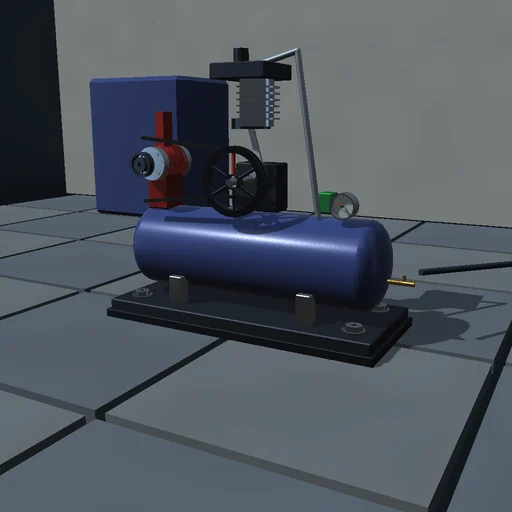
Start a single-cylinder compressor on a ten-litre receiver and watch the gauge climb: each stroke draws air through the intake plate, squeezes it hot and pushes it past the delivery plate once the cylinder beats the tank. The mass delivered per cycle shrinks as the tank fills, close to the clearance-volume closed form 1 - c ((p/p0)^(1/n) - 1); a larger clearance delivers less. At the set pressure the switch stops the motor, the unloader vents the cylinder and the machine coasts to rest; open the consumer and the tank settles where delivery meets the bleed. Motor work and intake enthalpy are booked against the gas’s internal energy, the heat to wall and room and the air sent on.
What happens
A shunt motor drives an 80 mm compressor by a belt; the slider-crank sweeps the cylinder, the intake and delivery plates open linearly over 0.2 bar and pass compressible flow by the Saint-Venant function, the cylinder gas exchanges heat with its wall and the receiver with the room, a consumer bleeds the receiver through an orifice, and a pressure switch stops the motor at the set pressure, whereupon an unloader vents the cylinder. RK4 at 20 µs on angle, speed and the two gas masses and temperatures, with every flow, work and heat booked at the step ends; the delivery per cycle is read against the clearance-volume closed form.
Try this
Watch the receiver fill and the delivery per cycle shrink; compare it with the clearance closed form; let the switch stop the motor and the unloader vent; then open the consumer and find the balance pressure.
The model and its limits
Ideal gas with constant specific heats, plate valves without mass or bounce, a lumped wall temperature, no oil or ring leakage, a straight motor line. Efficiencies are those of this idealized machine.
Equations used in the module
Equations
V(θ) = c·V_s + A·(2r − x(θ)),  G = A·p_u·Ψ(p_d/p_u)/√(R·T_u)
c_v·m·dT/dt = c_p·T_in·G_in − c_p·T·G_out − p·dV/dt + h·(T_w − T) − c_v·T·dm/dt
J·dω/dt = T_s·(1 − ω/ω_0) + (p − p_0)·dV/dθ − T_f − c·ω
η_v = 1 − c·((p_r/p_0)^(1/n) − 1)