Engineering
Stirling mechanism
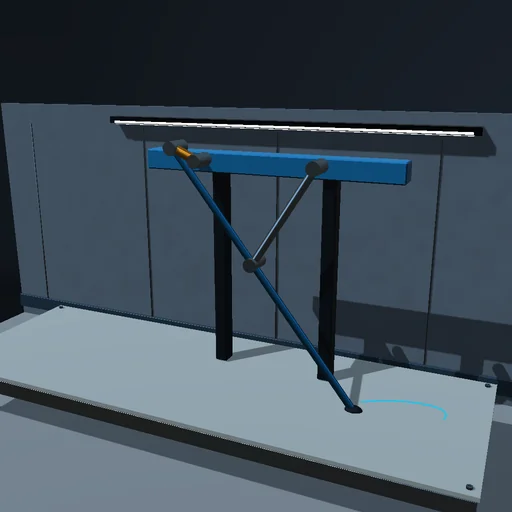
Spin a beta-type Stirling engine whose hot cap stands at 650 K and whose cold space is kept at 300 K: the displacer moves the air between them, the power piston a quarter turn behind takes the work, and the pressure follows the Schmidt law M R / (Vh/Th + Vc/Tc + Vr/Tr). Read the cycle work against the Schmidt closed form and the heat in and out against Carnot’s efficiency; load the brake until the engine stalls; cool the hot end and watch the work shrink; set both ends to one temperature and the flywheel coasts to a stop. Change the phase angle and find the ninety-odd degrees that give the most work. The gas work is booked against the flywheel, the friction and the brake.
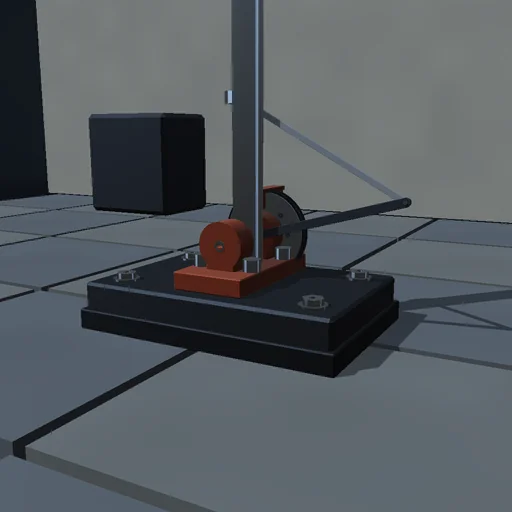
What happens
A beta Stirling engine in the Schmidt idealization: the displacer shuttles 100 cm³ of air between a hot space at 650 K and a cold space at 300 K, the power piston of 50 cm³ lags it by 90°, the regenerator sits at the log-mean temperature, each space is isothermal, so the pressure is M·R/(V_h/T_h + V_c/T_c + V_r/T_r) at every crank angle and the torque (p − p_charge)·dV_p/dθ. The crank carries a flywheel of 0.02 kg·m² against friction and a brake; RK4 at 0.1 ms with the cycle integrals of p·dV by Simpson on each step. The cycle work is compared with the Schmidt closed form, the heat in and out give Carnot’s efficiency, and the gas work meets the flywheel, friction and brake to rounding.
Try this
Read the cycle work against the Schmidt closed form and the efficiency against Carnot; load the brake until the engine stalls; cool the hot end; set both temperatures equal and watch it coast down; try other phase angles.
The model and its limits
Isothermal spaces and a perfect regenerator (the Schmidt idealization), sinusoidal volumes, no flow losses, leakage or dead-volume heat transfer. Work and efficiency are those of the ideal cycle.
Equations used in the module
Equations
p = M·R/(V_h/T_h + V_c/T_c + V_r/T_r),  T_r = (T_h − T_c)/ln(T_h/T_c)
V_h = V_dh + ½V_D·(1 + cos θ),  V_p = ½V_P·(1 + cos(θ − φ))
W = −½V_P·M·R·sin(β − φ)·(2π/B)·(1 − S/√(S² − B²))
η = W/Q_h ≤ 1 − T_c/T_h