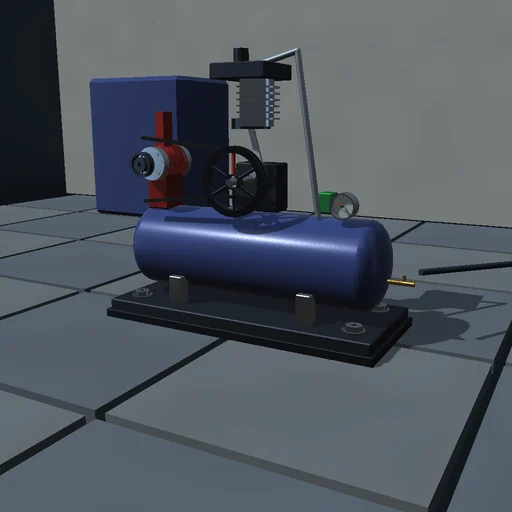
Engineering
Valve-controlled actuator
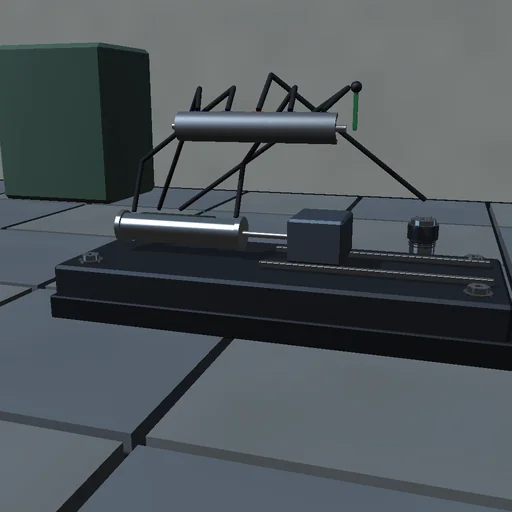
Move the command of a four-way spool and watch the slide follow: with a closed-centre spool nothing happens inside the lap, then the speed lands on the quasi-static balance of the two metering orifices and friction, and at null the load is held tight. Switch to an open-centre spool and the valve leaks 2 Cd w u sqrt(ps/rho) at null while both chambers sit at half the supply, but the smallest command tilts the pressures steeply towards the load. Push against the slide and read the pressure difference it needs. The supply’s pQ is booked against the throttling, the load’s Fv, the friction and the oil’s compression.
What happens
A four-way spool valve meters 100 bar oil to a symmetric cylinder sliding a 100 kg block on rails. The spool follows the command through a 5 ms lag; its four slots open by w·(x − u) for a closed-centre (overlapped) spool or w·(x + u) for an open-centre (underlapped) one, so the first has a deadband of the lap and the second a null leakage and a steep pressure gain. Turbulent orifice flows feed two compressible chambers, the piston carries the mass against Coulomb and viscous friction, an external force and elastic end stops. RK4 at 20 µs with the chamber pressures held above the tank’s; the supply’s pQ meets the throttling, the load’s Fv, the friction and the compression to rounding.
Try this
Give a small command and nothing moves inside the lap; a larger one and the slide runs at the orifice balance. Switch the centre open and read the null leakage and the pressure gain with the slide held.
The model and its limits
Rectangular slots without radial clearance or flow forces, a first-order spool, constant bulk modulus, friction as tanh. Gains and leakages are those of this idealized spool.
Equations used in the module
Equations
A_PA = w·(x − u) (closed centre),  A_PA = w·(x + u) (open centre)
Q = C_d·A·√(2Δp/ρ),  dp_A/dt = (β/V_A)·(Q_PA − Q_AT − A·v)
m·dv/dt = (p_A − p_B)·A − F_fr(v) − F_ext + F_stop
Q_null = 2C_d·w·u·√(p_s/ρ),  p_L = p_s·((u+x)² − (u−x)²)/((u+x)² + (u−x)²)