Physics / Engineering
Electric motors
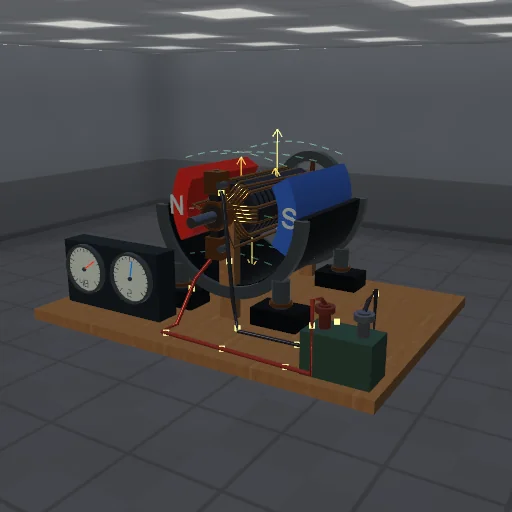
Compare a DC motor and generator with a separate three-phase FOC machine. Change the load and follow phase currents, rotor motion, speed and torque.
What happens
Compare a DC motor and generator with a separate three-phase FOC machine. Change the load and follow phase currents, rotor motion, speed and torque.
A current loop between two magnet poles feels a torque and turns toward alignment - exactly Induction's generator physics, run in reverse. Turn the commutator off and the loop just rocks back and forth like a compass needle, never completing a turn, no matter how strong the field: released from rest, energy alone won't let it swing past its own starting angle. Turn the commutator on, and the same loop spins without limit - a real split-ring commutator reverses the current every half-turn, always at the two positions where the torque is zero anyway, so the loop never feels a moment trying to push it backward. Reverse the battery and it spins the other way; add a viscous load and it settles to a steady speed that climbs with current and field strength.
Equations used in the module
Equations
τ = N I A B sin θ
ε_back = N B A ω
I = (V − ε_back) / R,   P = τ ω
FOC (p = 1):
vd = R id + L did/dt − ωe L iq
vq = R iq + L diq/dt + ωe (L id + ψ)
τ = 3 p ψ iq / 2;  P = 3 (vd id + vq iq) / 2