Physics
Lissajous figures
Perpendicular oscillations combined: the oscilloscope classic.
What happens
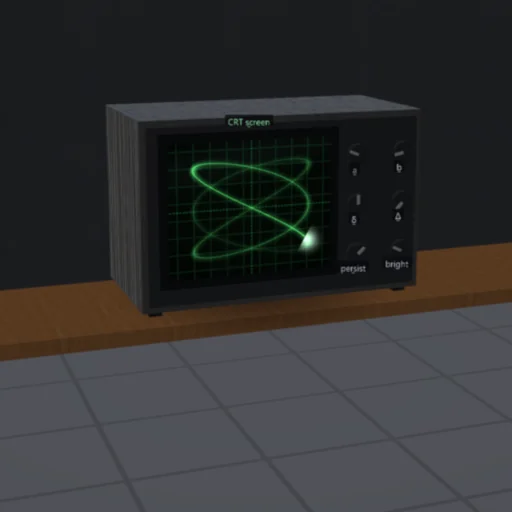
Two perpendicular oscillations on the phosphor of an oscilloscope in XY mode: when the frequency ratio a:b is a whole fraction the beam writes a closed figure - count the lobes and read the ratio off the screen. The persistence knob is honest phosphor memory: short, and you watch the writing spot; long, and the whole figure stands. Detune the generators by a few millihertz and the phase between them slowly advances - the figure tumbles through its whole family without end. The XYZ mode adds a third oscillator and lifts the figure into space as a glowing Lissajous knot. The Springs mode is the bench behind the picture: a puck held by four springs on the table, two along x and two along y, a pen under it writing on a slate. The frequency ratio comes out of the stiffnesses - Kx:Ky = 4:9 is 2:3 - and the panel prints the measured frequencies beside the linearised ones: pretension couples the axes, a large amplitude bends the geometry, and the real figure tumbles where the two generators of the scope would lock.
Equations used in the module
Equations
x = A sin(ω₁ t + δ),   y = B sin(ω₂ t)
closed curve when ω₁/ω₂ is rational
δ sets the phase: line, ellipse, circle