Astronomy
Exoplanet observatory
Reveal an unseen planet with transit photometry and stellar radial velocity. Record noisy observations, infer radius and mass, and explore the limits of those inferences.
What happens
Reveal an unseen planet with transit photometry and stellar radial velocity. Record noisy observations, infer radius and mass, and explore the limits of those inferences.
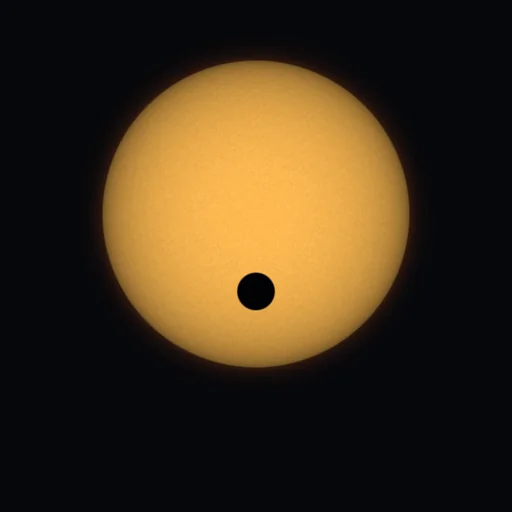
One opaque dark planet, one spherical star, fixed Kepler orbit; no spots, atmosphere, reflected/thermal planetary light, secondary-eclipse signal, TTV or other bodies. The stellar disk is a magnified geometric explanation, not a resolved image from a real exoplanet telescope. Transit zero minimizes the foreground projected separation; each contact is solved independently. Quadratic limb coefficients are restricted to u1>=0, u2>=0, u1+u2<=1, so intensity stays nonnegative. Photometry integrates the occulted intensity and finite exposure, with optional constant third light. RV is positive away from the observer and has no arbitrary display gain in the calculation. Synthetic campaigns use uniform sampling and independent Gaussian errors specified per exposure/visit; changing exposure does not automatically change the requested noise. RV samples are instantaneous. Fits condition on known P, phase, e, omega, inclination, a/R*, stellar properties, limb law and dilution; they estimate k, K and offsets, not all system parameters. Reported errors are local formal 1-sigma errors; no stellar/geometry uncertainty or correlated noise. A 3-sigma threshold is an illustrative fixed-template signal check, not a blind survey false-alarm probability. Mean density has compositional degeneracies. B, recorded samples and display magnifications are separate.
The model and its limits
One opaque dark planet, one spherical star, fixed Kepler orbit; no spots, atmosphere, reflected/thermal planetary light, secondary-eclipse signal, TTV or other bodies. The stellar disk is a magnified geometric explanation, not a resolved image from a real exoplanet telescope. Transit zero minimizes the foreground projected separation; each contact is solved independently. Quadratic limb coefficients are restricted to u1>=0, u2>=0, u1+u2<=1, so intensity stays nonnegative. Photometry integrates the occulted intensity and finite exposure, with optional constant third light. RV is positive away from the observer and has no arbitrary display gain in the calculation. Synthetic campaigns use uniform sampling and independent Gaussian errors specified per exposure/visit; changing exposure does not automatically change the requested noise. RV samples are instantaneous. Fits condition on known P, phase, e, omega, inclination, a/R*, stellar properties, limb law and dilution; they estimate k, K and offsets, not all system parameters. Reported errors are local formal 1-sigma errors; no stellar/geometry uncertainty or correlated noise. A 3-sigma threshold is an illustrative fixed-template signal check, not a blind survey false-alarm probability. Mean density has compositional degeneracies. B, recorded samples and display magnifications are separate.
Equations used in the module
Equations
a^3=G(Mstar+Mp)P^2/(4pi^2); E-e sin(E)=M; t=0 at the minimum foreground sky separation
X=-r cos(omega+f), Y=-r sin(omega+f) cos(i), Z=r sin(omega+f) sin(i), Z toward observer
Contacts: sqrt(X^2+Y^2)/Rstar = 1 +/- k; solve ingress and egress independently
I(mu)=1-u1(1-mu)-u2(1-mu)^2; F=1-[occulted integral / (pi*(1-u1/3-u2/6))]/(1+dilution)
Exposure flux = integral(F(t), exposure interval) / exposure duration
K=(2piG/P)^(1/3) Mp sin(i)/(Mstar+Mp)^(2/3)/sqrt(1-e^2)
v_r=gamma+K[cos(omega+f)+e cos(omega)]; v_r=-dZstar/dt
rho=Mp/(4pi Rp^3/3); radius and mass fits are conditional on fixed geometry and star properties.