Engineering
Filament 3D printer
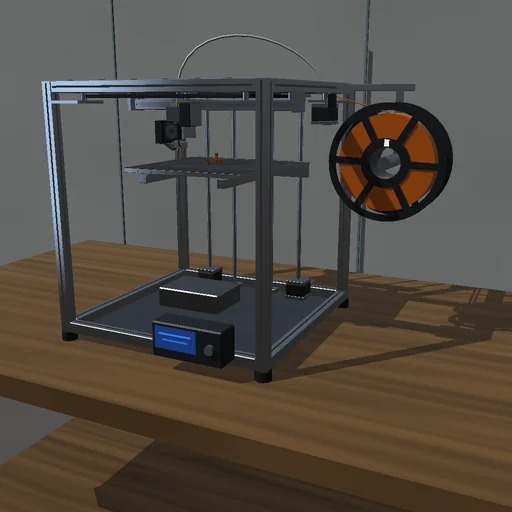
Print two pillars joined by a bridge and a thin tower beside them, and watch the melt laid road by road, the free strands sag until they stiffen and the tower's top stay soft. Change the flow and the speed to see the bead swell or thin, switch the fan off or widen the span to make the bridge droop, and set a minimum layer time to let the tower cool.
What happens
A CoreXY filament printer lays a PLA test part: two pillars 6 mm square and 10 mm tall joined by a bridge of 13 free strands, and a tower 4 mm square and 20 mm tall beside them, in layers of 0.2 mm with lines 0.45 mm wide. Every move starts and ends at rest and accelerates at 3 m/s², so a short one never reaches the set speed. The extruder pushes the slicer's line of melt, but the hot end melts only so much: at 210 °C the filament's core reaches its flow point within the melt zone up to 7.60 mm³/s, so a full bead is laid only up to 84.5 mm/s. Every layer is a heat node and the road being laid is followed in cells that conduct into the layer below; the part loses heat to the air in the fan's jet and by radiation, and its first layer to the heated bed. A strand over the gap cools in the air and sags as a viscous thread until it stiffens below 70 °C.
The print takes 322 s and lays 1039 mm³ of melt: 5.22 s a layer while the pillars rise, 8.74 s for the bridge layer, 1.03 s a layer for the tower alone. A strand is anchored 0.167 s after its middle was laid, at 149 °C; with the fan it cools with a time constant of 0.414 s and the 20 mm bridge sags 0.735 mm, a 40 mm span sags 1.14 mm. With the fan off the time constant is 1.88 s and the bridge sags 2.01 mm. The tower printed alone keeps a soft top, about 4.0 mm deep with the fan and 11.6 mm without it; below the top its heat decays over 3.34 mm, as in a growing fin. A minimum layer time of 10 s keeps the top nearly firm. A flow of 120 % lays a bead 0.54 mm wide, 80 % one of 0.36 mm with gaps between the lines. At 120 mm/s the hot end starves the long roads: the strands are laid 0.317 mm wide, the print lays 975 mm³ and is only 12 % faster.
Model: a fixed toolpath with exact stops at the corners and no pressure lag in the nozzle; the melt limit comes from the first radial mode of the filament's heating. Layers are lumped nodes, the road being laid is followed in cells of 1 mm; convection follows Kramers' law for the fan's jet and radiation is linearized. The sag is the stretching of a viscous thread lumped at its middle and counted from its anchoring; there is no fusion strength, crystallization or warping. RK4 with steps of 1/120 s; the volume fed equals the volume in the part, and the heat journal of melt, convection, radiation, bed and stored heat closes.
Try this
Watch the first layers, then the bridge and the tower printed alone, and read the sag and the soft top. Then switch the fan off, change the flow or the speed, or set a minimum layer time, and print again.
Equations used in the module
Equations
t = L/v + v/a  (L ≥ v²/a),  t = 2·sqrt(L/a)  (L < v²/a)
Q = min(k·w·h·v, Q_max),  w_bead = Q/(v·h)
Q_max = A_f·L_m / (τ_f·ln((T_n − T_0)/(T_n − T_flow)))
T = T_a + (T_0 − T_a)·e^(−t/τ),  τ = ρ·c·d / (4·(h_c + h_r))
d(δ³)/dt = 3·ρ·g·L⁴ / (128·μ(T))