Engineering
Laser cutting table
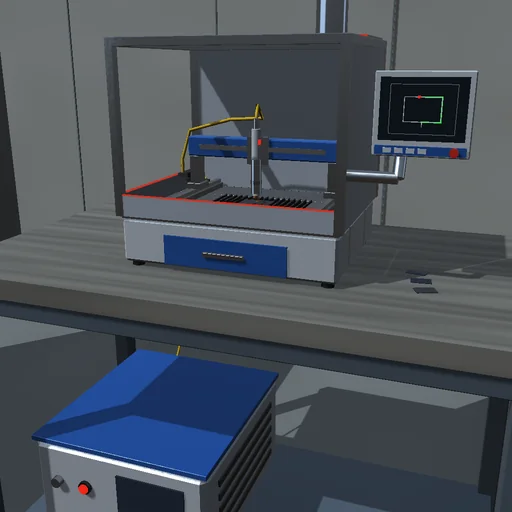
Cut a part out of a steel sheet with a laser: the beam melts the steel through, the gas blows the melt out of the kerf and the head follows the contour. Raise the feed until the cut stalls, make the head dwell at the corners, try a second pass, and watch where the beam's energy goes.
What happens
A benchtop laser cutting table cuts a part out of a steel coupon 64 × 48 mm and 1 mm thick lying on the sawtooth slats of its bed. The gantry carries the cutting head round its programme – a pierce in the scrap, a 5 mm lead-in, the contour, 1 mm of overcut – at the set feed, stopping at every corner. The beam is a Gaussian spot 2 mm across; the steel absorbs 35 % of what falls on it and reflects the rest, and what falls into the kerf passes through. The sheet is a grid of 0.5 mm cells, each with one temperature through its thickness: heat spreads by conduction, both faces lose it by convection and radiation, and a cell molten through at 1500 °C is blown out of the kerf by the gas with its heat.
At 2 kW and 25 mm/s the rectangle is cut through in 5.4 s with a kerf 1.04 mm wide. Below melting the sheet follows the linear thin-plate equation: on a straight pass at 105 W absorbed and 20 mm/s the exact solution for a moving Gaussian spot heats the cell under the spot by 392 K and the sheet 10 mm behind by 166 K, where Rosenthal's line source gives 169 K; the grid agrees within 2.2 %. Above 50 mm/s no cell melts at all, and the balance alone would allow 77 mm/s, yet the cut stalls at 40 mm/s: the melt must be heated through while conduction takes its share. At 45 mm/s the track melts but stays uncut after the lead-in; a second pass finds it preheated and cuts 97 % of the contour, but one pass at 22.5 mm/s, the same beam energy per millimetre, cuts it all and the sheet absorbs a quarter less. Half a second at each corner sends most of the dwell's beam through the kerf, and the rest burns the corners and spreads the zone heated past 727 °C. Two rounds at 300 W, which melt nothing, superpose: the second runs 47.9 K hotter. With the beam off the heat only decays, by 4.2 % a second.
Model: a thin plate with one temperature through the thickness and mean properties of steel; the melt leaves at the melting point, without gas flow or oxidation; radiation linearised about 1000 K; the spot and the kerf are several times a real machine's so that the cells resolve them; the grid's error under the spot falls fourfold when the cell is halved. Finite volumes, Heun's second-order step of 1/240 s inside the stability limit of 9.8 ms. The journal closes: the beam's energy is reflected, passes through the kerf, leaves with the melt, is lost from the faces or stays in the sheet.
Try this
Watch the head cut the rectangle at 2 kW and 25 mm/s, then raise the feed until the cut stalls. Try two passes, the dwell at the corners and a thicker sheet, and compare where the beam's energy goes.
Equations used in the module
Equations
ρ·c·d·∂T/∂t = k·d·∇²T − 2H·(T − T₀) + α·I,  I = 2P/(π·w²)·exp(−2r²/w²)
H = h_c + 4·ε·σ·T_r³,  b = 2H/(ρ·c·d),  P = 0:  T − T₀ ∝ exp(−b·t)
E ≥ m·(c·(T_m − T₀) + L)
T − T₀ = q/(2π·k·d)·exp(−v·ξ/2a)·K₀(r·√((v/2a)² + b/a))