Engineering
Glassblowing studio
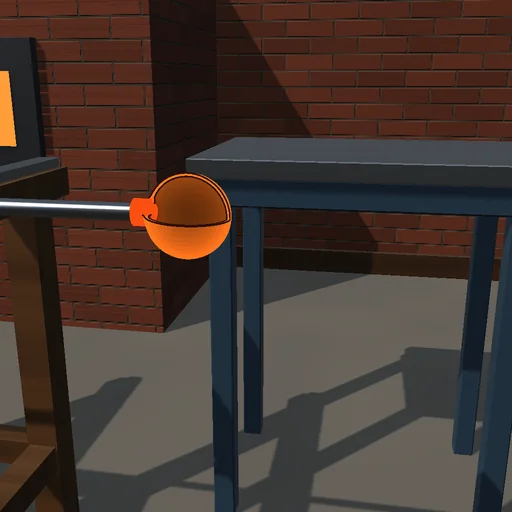
Blow a gather of hot glass on a pipe into a bubble while it cools: set the pressure, keep the pipe turning and carry it into the glory hole to reheat. Compare a cold and a hot gather, stop turning to watch the bubble droop, and blow a gather with a thin end with and without the cooling jet.
What happens
A gather of 300 g of soda-lime glass on the end of a blowpipe is blown into a bubble at the gaffer's bench. The glass's viscosity follows the Vogel–Fulcher–Tammann law, log₁₀(η/Pa·s) = −2.6 + 4300/(T − 530 K): a thousand pascal-seconds at 1025 °C, four thousand times more at 724 °C. Inertia is negligible, so the glass moves by Stokes flow: of all the ways the wall can stretch – at rates s along the meridian and t round the bubble – the one that dissipates least for the work of the air pressure and the surface tension. The bubble is kept a sphere through the 12 mm ring of glass stuck to the pipe's mouth; 24 rings of glass slide on it, each with its own wall and temperature. They radiate (emissivity 0.9) and lose heat by convection to the room and to the pipe at the neck, or take it from the glory hole's walls at 1200 °C; a jet of air may cool the far end. Gravity bends the neck like a viscous hinge; turning the pipe carries the droop round.
By the thin-shell law an even free sphere runs away: at 1000 °C the parison, 26.7 mm in mid-radius with a 14.1 mm wall, blown at 0.5 kPa would do so in 6.14 s. Cooling stops it: on the pipe it grows to 156 mm in 30 s and stiffens at 672 °C, its neck, cooled by the pipe, 6.1 times as thick as the far end's 1.5 mm. A gather at 850 °C barely opens, to 67.9 mm, while a free sphere at 1100 °C tears in 1.48 s. Not turned, the bubble droops 61.8° in 3 s and hangs 73.7° off the pipe in 8 s; turned once a second it circles back and is left 4.2° off the axis. Where the end has half the wall it thins 1.8 times as fast as the body: at the same pressure it finishes at 1.18 mm against 1.53 mm, and at 0.75 kPa it tears in 5.76 s. The cooling jet stiffens the end and stops its stretch at 4.85 mm while the bubble reaches 110 mm.
Model: a thin viscous shell kept spherical, so a thin spot spreads along the sphere instead of bulging out; at the start the wall is half the radius, where the thin-shell law runs 6 % ahead of the exact thick shell. One temperature through each ring's wall, a grey opaque surface; the neck is the first ring bending as a viscous tube; no centrifugal force, no sag of the bubble itself, no air flow in the pipe; a wall under 0.25 mm tears and the bubble holds no more pressure. RK4 at 1/120 s, cut finer while the wall stretches fast; glass is neither made nor lost, and the journal of blowing, glory hole, radiation, convection, pipe, heat and surface energy closes.
Try this
Watch the gather swell under the blowing pressure and stop as it cools, then carry it into the glory hole and blow again. Stop turning the pipe to see the bubble droop, and blow a gather with a thin end with and without the cooling jet.
Equations used in the module
Equations
log₁₀(η/Pa·s) = −2.6 + 4300/(T − 530 K)
∫ 2ηh·(s² + t² + s·t) dA − (Δp·V′ − 2γ·A′)·dR/dt → min
dR/dt = (Δp − 4γ/R)·R²/(12·η·h)
ρ·c·h·dT/dt = −(1 + h/2R)²·[ε·σ·(T⁴ − T_room⁴) + a·(T − T_room)]
dα/dt = k·cos α,  k = m·g·L·l/(3·η·I)