Engineering
Sewing machine
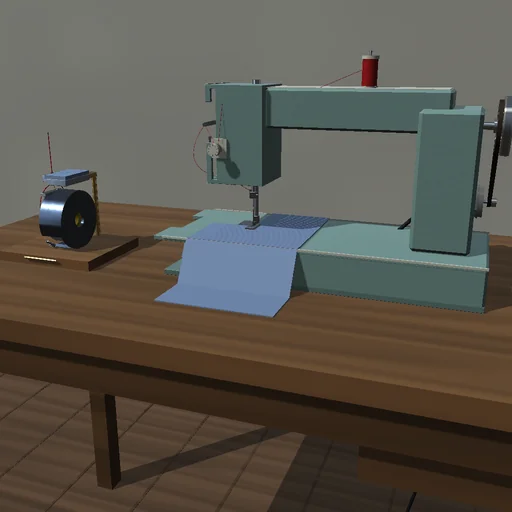
Sew a lockstitch seam in slow motion: the needle carries the thread down, the rotary hook catches its loop under the plate, and the take-up lever pulls the stitch tight while the feed dog moves the cloth. Retime the hook to miss stitches, unbalance the tensions to pull the lock to one face, compare short and long stitches, and press the pedal lightly on thick denim until the motor stalls.
What happens
A lockstitch machine sews cotton 1.5 mm thick with a red needle thread and a yellow bobbin thread. A 24 V DC motor drives the main shaft through a 5:1 belt, its voltage set by the pedal. The shaft lowers the needle bar by a crank of 15 mm and a rod of 45 mm, works the take-up lever by a cam, turns the rotary hook at twice its speed and moves the feed dog, which carries the cloth one stitch length while the needle is out of it. As the needle rises from its lowest point, the cloth holds the thread on the needle's scarf side and the slack bows out into a loop, 0.4 ms behind the rise. The hook's point catches it if it passes at least 0.3 mm above the eye where the loop stands at least 1.2 mm out. The discs let the needle thread slip at T = 0.05 N·e^(0.2π) + 2·0.2·N, the dial's spring giving 0.125 N a number.
At half pedal the machine settles at 541 stitches a minute and catches a 1.70 mm loop with the hook at 25° after the lowest point. Turned by hand it catches between 15.4° and 34.2°: at 10° the loop is 0.78 mm and every stitch is missed, at 36° the point passes under the eye. Near the early edge speed decides: at 17° the hand catches a 1.30 mm loop and half pedal a 1.21 mm one, but full pedal, 1103 stitches a minute, leaves 1.12 mm and catches nothing. A missed stitch leaves a double run. At dial 4 the discs give 0.294 N against the bobbin's 0.30 N: the lock sits 51.7 % down, and a 2.5 mm stitch keeps 4.05 mm of needle and 3.95 mm of bobbin thread. Dial 9 pulls the lock to the top face, dial 0 lets it lie on the under face. Short stitches spend more: 5 m of thread per metre of seam at 1 mm, 2.75 m at 4 mm. In 6 mm denim a pedal at 5 % stalls after 0.56 s with the needle in the cloth; from 7.4 % the motor beats the largest static resistance.
Model: the needle bar is an exact crank-slider; the take-up lever, the hook's loop and the feed are programs of the shaft's angle, and the shaft is one body with the bar's varying inertia, friction and a motor without inductance. The cloth resists the needle in proportion to its thickness; the presser foot's friction loads the feed. The loop is a circular bow, the lock's place a linear balance against the cloth's grip; threads have no thickness, fibres and seam strength are not modelled. RK4, steps of at most 0.1 ms; the thread drawn equals seam, path and slack at every step, and the energy journal closes on mains, windings, friction, needle, feed, discs and the shaft's energy.
Try this
Watch a stitch form in the 4:1 model beside the machine, then move the hook's timing until stitches are missed. Turn the tension dial to pull the lock to either face and compare the thread short and long stitches take.
Equations used in the module
Equations
x(θ) = √(l² − r²·sin²θ) − r·cos θ,   J(θ)·dω/dt = Q − ½·J′(θ)·ω²
de/dt = (u − e)/τ,   α/sin α = (c + e)/c
T = T₀·e^(μθ) + 2·μ·N
z/t = ½ + (T_b − T)/(2·G·t)
l_n = l + 2z,   l_b = l + 2(t − z)