Engineering
Offset printing press
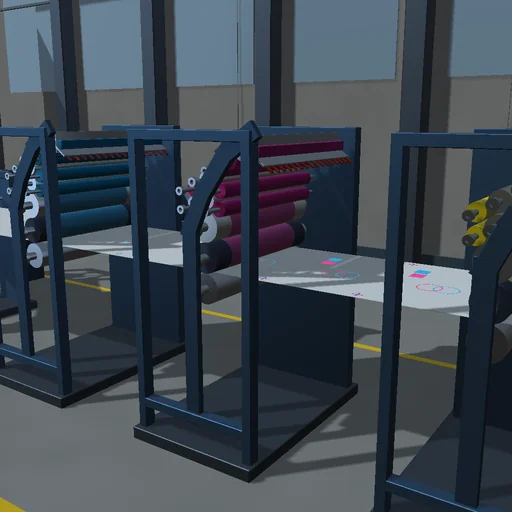
Run the paper web through three printing units and bring magenta and yellow onto cyan with the phase trims. Then change the web tension, ramp the press up faster, open the magenta ink key, switch to heavy paper or splice a new reel, and watch the colours drift with the paper's stretch and settle again.
What happens
A web offset press prints a paper web 0.9 m wide in three colours. Paper runs off a 1.2 m reel, round a dancer roller loaded by an air cylinder for 250 N, through a driven infeed nip, three printing units - cyan, magenta and yellow, each a plate, blanket and impression cylinder with its own servo drive - and a pull roll to the folder. The web is an elastic band (EA 405 kN for light paper, 990 kN for heavy) in five spans; a roll that runs faster than the one before stretches its span until (1 + ε) = (1 + ε_up)·v/v_up. The infeed runs 0.0123 % slower than the units for 300 N in the printing spans. Each unit lays its image where the paper is under its nip; the register is the difference of the image coordinates two units gave the same paper. The magenta plate sits 0.35 mm ahead of cyan, the yellow one 0.20 mm behind.
Trims that cancel the plates bring both colours onto cyan at any steady tension: with equal cylinder speeds the paper takes L/v from nip to nip however much it is stretched. A ramp from crawl to 12 m/s at 1.5 m/s² moves the colours by less than a micrometre; with heavy paper the reel's 6 kW motor is at its limit above 9.5 m/s and the dancer pays out 72 mm. At 2.5 m/s² a full reel needs more than the motor's 400 N·m: it falls behind, the dancer hits its stop after 1.79 s, the web snatches the reel up to speed with 1.30 kN and the colours swing by up to 1.47 mm. Raising the tension from 300 to 450 N shifts magenta by 0.083 mm and yellow by 0.147 mm for about a second while the stretched paper travels, then both return. A flying splice swings the dancer by 9.3 mm. Opening the magenta key from 40 to 60 % thickens the film from 0.96 to 1.44 µm with a lag of 96 revolutions: the density rises from 1.36 to 1.59 in 5 s.
Model: a massless web, elastic, slack below zero strain, one strain per span and the strain of the span before on each roller; a 15 kg dancer between stops; PI speed loops with inertia feed-forward on the infeed, the pull roll and the reel, PID servos locked to the master on the units, every drive limited in torque and power; the reel's inertia shrinks with its paper. No slip, fan-out or moisture; one ink store per unit. RK4 with steps of 1 ms. The journal closes on the drives', the dancer cylinder's and the folder's work against drag, creep, damping and the energy carried off with the paper; paper and ink are conserved.
Try this
Look at the crosses on the console and on the web: magenta and yellow are off. Trim their phases until they sit on cyan, then raise the tension, ramp faster or splice a new reel and watch the colours move and come back.
Equations used in the module
Equations
dU/dt = v_up/(1 + ε_up) − v/(1 + ε),  ε = L/U − 1,  T = EA·max(ε, 0)
dU/dt = 0:  (1 + ε) = (1 + ε_up)·v/v_up,   v = v_up:  Δt = L/v
Δx = X_unit(σ) − X_cyan(σ)
J·dω/dt = M + (T_out − T_in)·R − M_drag,  |M| ≤ min(M_max, P_max/ω)
dV/dn = k·q − C·w·c·s·V/A,  D = D∞·(1 − e^(−h/h_D))