Engineering
Combine harvester
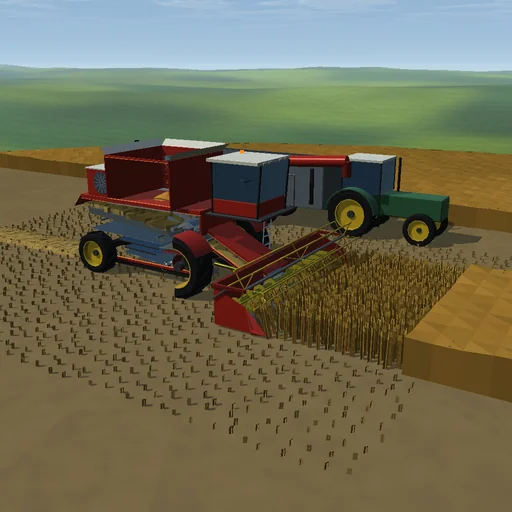
Harvest a strip of wheat and follow the crop from the header through the drum, the straw walkers and the sieves into the grain tank while every loss is counted. Drive faster in a heavy crop until the walkers lose grain and the drum chokes, set the drum, the concave gap and the fan, and unload before the tank spills.
What happens
A combine with a 6 m header cuts wheat of 8 t/ha, with 0.8 kg of straw and chaff for every kilogram of grain. The crop passes five stages, each holding what it receives and letting it out at M/τ: the header and feeder, the threshing drum of 600 mm over its concave, five straw walkers, the cleaning shoe with its fan and two sieves, and the elevator to a tank of 9 m³. Explicit laws split what leaves each stage: the grain left in the ears falls exponentially with the square of the rasp bars' speed and rises with moisture, the concave lets most of the threshed grain through, the grain left in the straw at the walkers' end climbs steeply with the straw they carry, and the fan blows out the chaff and, too strong, the grain as well. The drum takes Goryachkin's torque q·u·R/(1 − f) from a 200 kW engine whose governor droops under the load and slows the drum, the fan and every conveyor.
At 5 km/h the machine takes 43.2 t/h of crop and the engine gives 105 kW at 2174 rpm; the drum, set to 950 rpm, turns at 918 rpm. 0.16 % of the grain stays in the ears, 0.39 % rides out in the straw and 0.26 % leaves the shoe, 0.81 % in all, and 23.8 t/h reach the tank. Driving faster loads the walkers: the losses reach 1.5 % at 6.19 km/h and 3.22 % at 8 km/h. Above about 10.1 km/h the engine cannot carry the machine, and at 12 km/h the drum chokes after 10.7 s. A fan at 400 rpm leaves 88 % of the chaff blanketing the sieves and the shoe loses 1.70 %; at 1450 rpm it blows 6.19 % of the grain out. Grain at 20 % moisture leaves 1.29 % in the ears and 0.91 % in the straw. A 20 mm gap leaves 2.06 % unthreshed but breaks 0.83 % of the kernels instead of 1.07 %. The tank fills in about 18 min and the auger empties it at 90 kg/s.
Model: every stage is a well-mixed holdup whose transit time shortens with the engine's speed; the separation laws are explicit, educational dependencies, not a model of the ears, the straw mat or the air, and the field is uniform. The drum chokes when the engine is dragged below 60 % of its high idle; clearing it backs the slug into the header. The engine is a static torque curve with its governor's droop, and the machine's own motion is left out of the energy. RK4 with steps of 10 ms; the crop's mass closes exactly, and the journal balances the engine's work against threshing, separation and cleaning, travel, unloading and the rotating parts.
Try this
Watch the crop pass from the header to the tank and the losses settle. Then drive faster in a heavy crop until the walkers lose grain and the drum chokes, try the fan, the gap and a wet crop, and unload before the tank is full.
Equations used in the module
Equations
q_g = B·v·Y,  q_MOG = 0.8·q_g,  dM/dt = q_in − s·M/τ
L_ears = exp(−7·(u/30 m/s)²·(12 mm/g_c)·e^(−6.6·(w − 0.14)))
L_straw = exp(−18 kg/s·e^(−4·(w − 0.14))/(Q_straw + 0.1 kg/s))
M_drum = q·u·R/(1 − f),  f = 0.6 + 0.35·(x/2)²
(J_e + J_d·r²)·dω/dt = T_e(ω) − r·M_drum − P_other/ω