Engineering
Telescope tracking mount
Slew the alt-azimuth telescope to a star and keep its image on the camera's crosshair as the sky turns, while the worms' backlash, their periodic error and the wind push it away. Let a star pass near the zenith to see the azimuth drive run out of speed, carry a star across the meridian with the encoder on the motor, and raise the loop's bandwidth against the gusts.
What happens
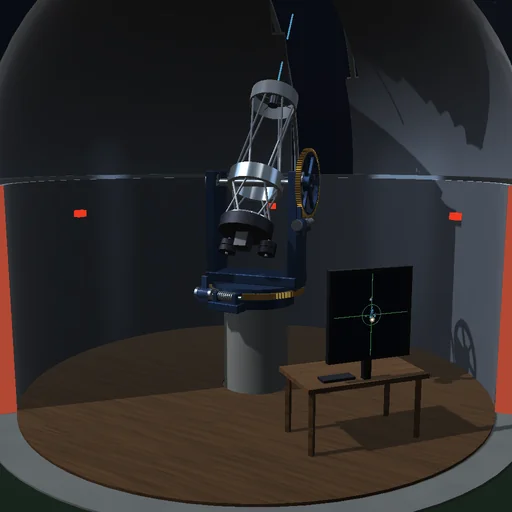
An alt-azimuth telescope stands on its pier in a turning dome. The sky turns once in 86164 s; the star's altitude, azimuth and the rates the axes must keep follow from the latitude, its declination and hour angle. Each axis carries its drive's inertia behind a worm mesh, a stiff spring that acts only beyond the backlash and carries the worm's periodic error of ±5″, once per tooth of a 360-tooth wheel. DC motors limited to 8 N·m and by their voltage turn the axes no faster than about 1.1°/s. The controller places three poles at the bandwidth, adds rate and acceleration feedforward from the ephemeris and reads an encoder on the axis or on the motor; a slew brakes on a square-root curve. The monitor shows the camera's frame magnified, with a neighbour star 20″ away that circles the target as the field rotates.
The meridian star, 60° high at its transit, needs 0.0078°/s of azimuth, and its field turns at 0.33°/min. The zenith star passes 0.1° from the zenith: its azimuth must swing at 1.6°/s, the drive falls behind, and half a minute after the passage the image is 121″ away, as a rate-limited follower predicts; at a latitude of 30° the error reaches 288″, at 65° the drive keeps up. From rest the loop lags 6.3″ without feedforward, 0.84″ with it. With the encoder on the axis the periodic error leaves nothing on the image; on the motor it passes whole, and 30″ of backlash moves the tube from 10.4″ below the star to 19.9″ above it when the altitude turns back after the meridian. Without backlash, seeded gusts of 1 N·m on each axis shake the altitude by 16.6″ RMS at 0.5 Hz of bandwidth, by 0.63″ at 2 Hz. A slew of 30° takes 28.4 s against a bang-bang bound of 27.97 s; with the drives off the star walks 858″ in a minute.
Model: the star's place and rates by spherical astronomy, without refraction or seeing; two axes coupled by the tube's inertia about the vertical, each driven through a worm mesh of 1e6 N·m/rad; Coulomb friction smoothed below 10″/s; exact encoders; the dome follows the tube; the worm is not self-locking, so the motor holds the wind. The zenith is the mount's singularity, where the azimuth rate grows as ω·cos δ/sin z. RK4 in steps of 1/240 s, cut finer where a worm takes up a flank; the energy journal closes on the work of the motors and the wind, the kinetic energy of the axes and drives, the mesh springs and the losses in the bearings, the drives and the mesh.
Try this
Watch the telescope slew from its park to the star, then follow the image on the monitor. Choose the zenith star to see the azimuth drive fall behind, or put the encoder on the motor and track past the meridian.
Equations used in the module
Equations
sin h = sin φ·sin δ + cos φ·cos δ·cos H,  H = H₀ + ω·t
dA/dt = ω·(sin φ − cos φ·tan h·cos A),  dh/dt = ω·cos φ·sin A,  dq/dt = −ω·cos φ·cos A/cos h
J·dω/dt = τ_mesh − T_c·tanh(ω/v_s) − b·ω + τ_wind,  τ_mesh = k·sign(δ)·(|δ| − β/2),  |δ| > β/2
u = 3J·a²·e + J·a³·∫e dt − (3J·a − b)·ω_d + u_ff,  −T_s·(1 + ω_d/Ω₀) ≤ u ≤ T_s·(1 − ω_d/Ω₀),  |u| ≤ T_max