Engineering
Mechanical music box
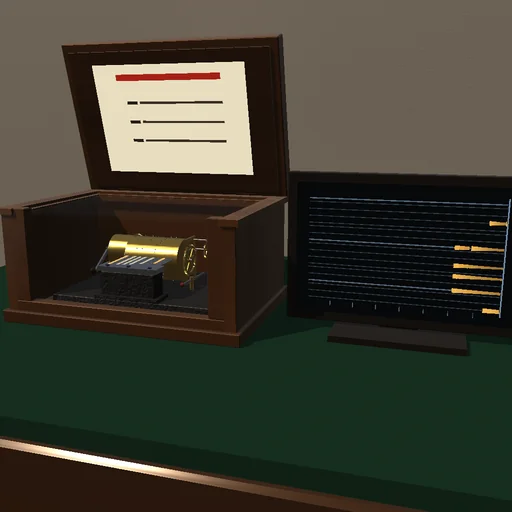
Wind the spring and watch the pinned cylinder pluck the steel teeth of the comb while the air-brake fly holds the tempo; the screen beside the box writes every note at the pitch it sounds. Make the fly's vanes smaller to play faster, let the spring run down until the box stops in a chord, damp the teeth, or shorten one tooth and see its note leave its row.
What happens
A cylinder music box in the Swiss manner. A steel mainspring of 4.09 mN·m per radian, wound four turns, turns the brass cylinder through the barrel's great wheel at 4:1, and the cylinder turns an air-brake fly through a train of 2160:1. The drag of its two vanes grows with the square of their speed, so a steady torque gives a steady tempo, ω = √((K·θ/G − T_f)/C). The cylinder's pins lift the 18 steel teeth of the comb, 0.5 mm thick and tuned to the C major scale from G4 to C7: the higher teeth by their length, f ∝ t/L², the five bass teeth by lead at their tips (44.3 mg for G4). A pin meets a tooth's tip 12° above the axis, lifts it 0.25 mm against its stiffness 3·E·I/L³ and slips off; the tooth rings in its first two bending modes, the second not a harmonic, and dies away.
From rest the first chord sounds after 1.198 s, and the governor settles at 95.8 beats a minute for Twinkle; lifting a four-tooth chord slows the music to 93.4, and the seven-tooth chord that ends the scale drags it from 77.4 to 70.1. With vanes of 5 mm instead of 10 the tune plays 1.42 times faster. As the spring runs down, the tempo falls by nearly the same amount every second: after 11.8 minutes and 1333 notes the last chord sounds at 16.7 beats a minute, the next one stops the train, and it rests with the teeth lifted 0.025 mm and 11.0 mJ, 0.85 % of the winding, still in the spring. Of the 1.292 J wound, the fly took 1.153 J and the teeth 52.8 mJ. An unweighted tooth keeps 97.07 % of a pluck in its first mode; C6 holds 13.9 % of it after one second, while its 6558 Hz second mode loses 71 % in a tenth. G6 shortened by half a millimetre sounds 109 cents sharp, its notes off their row on the screen.
Model: the train is one body reduced to the cylinder, nearly all its inertia the fly's, with the fly's quadratic drag and a Coulomb friction that holds a train at rest; the spring is linear. A pin is a point lifting its tooth quasi-statically, the tooth's period a thousandth of the lift; a lead weight is a point mass at the tip; each tooth rings in two exact modes, and what the higher modes take at the release is booked as the click; a pin meeting a ringing tooth stops it. No sound is radiated: the music's energy is the teeth's ringing. RK4 at 1/120 s with every event located inside its step; the energy journal closes on the winding, the spring, the fly, the friction, the pins' sliding and the teeth.
Try this
Look at the comb from close by while the pins lift the teeth, and at the screen beside the box, where every note is written at its pitch. Make the vanes smaller and compare the tempo, start with a short winding to see the box run down, or trim a tooth and find its notes off their row.
Equations used in the module
Equations
f = β²/(2π)·√(E·I/(ρ·A·L⁴)),   1 + cos β·cosh β + μ·β·(cos β·sinh β − sin β·cosh β) = 0
k = 3·E·I/L³,   y = R·sin φ − y₀,   E_pluck = ½·k·y²
I·dω/dt = K·θ/G − T_pins − T_f − C·ω²,   C = c·N³
ω = √((K·θ/G − T_f)/C),   dω/dt = −K/(2·G²·C)
E_n(t) = E_n(0)·e^(−η·ω_n·t)