Engineering
Pottery wheel
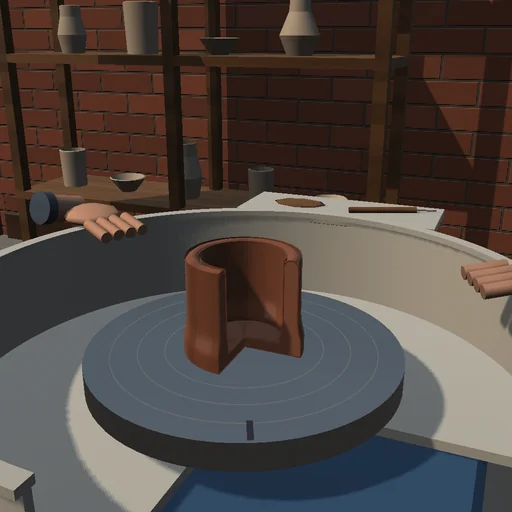
Pull the wall of an opened lump of clay up into a tall cylinder, pull after pull, watching the wall thin and the wheel slow under the hands. Use more water to see the soaked wall twist off, open a bowl and speed the wheel up to fling its rim, and try a softer clay or dry hands.
What happens
A potter throws a pot on an electric wheel from 1.5 kg of clay, centred and opened: a floor 12 mm thick, a wall 25 mm thick round a radius of 55 mm. The wall is a stack of 96 rings, each keeping its volume. Clay is a Bingham material: below its yield stress it does not flow, above it it flows with a plastic viscosity of 0.2 s times that stress; the yield stress falls a hundredfold from the plastic limit, 20 % water, to the liquid limit, 40 %: 17 kPa at 30 %. In a pull the fingers squeeze the wall with 30 N each over a patch 15 mm wide and 30 mm tall, drawn up at 1 cm/s; where the pressure passes twice the yield stress the clay is squeezed thinner and taller, the wheel bringing the whole ring under the fingers once a turn. For a bowl the inside hand also pushes outwards. A DC motor turns the wheel; the hands' friction, 0.5 for dry hands and 0.1 for wet ones, and the work of squeezing slow it. The water the potter uses lubricates the hands but soaks into the wall and softens it.
At 30 N the clay yields in a band 24 mm tall, and a steady pull leaves the wall at 0.658 of its thickness: 16.4 mm from 25 mm. Three pulls with wet hands raise the wall from 7.1 cm to 11.1, 15.7 and 24.4 cm, 7.7 mm thick on average; the water soaked in has softened its thinnest ring to 13.6 kPa, and a fourth pull twists the wall off at 19.1 cm, where the hands' torque exceeds what the thin wall can carry. With full water the wall twists off in the third pull, soaked to 7.6 kPa; dry hands pressing 40 N twist it off in the second, clay of 33 % water in the first. Dry hands slow the wheel set to 120 rpm to 113.6 rpm. A bowl opened to a rim of 13.4 cm holds at 200 rpm, but at 300 rpm its rim is flung 0.37 s after the pedal goes down, and ring after ring 127.6 cm³ of clay land in the splash pan.
Model: thin rings stacked straight up, the thickness measured across; the squeeze is averaged round the ring, in plane strain under the fingers; the push and the spin stretch rings round their circumference; the weight is carried straight down, so a flared wall does not sag. A wall tears where it is pinched below 1 mm, stretched freely by a quarter, or sheared past its yield by the hands' torque. RK4 at 1/120 s; the clay's volume changes only by the water soaked in, and the journal of motor, windings, bearings, friction, clay flow, lifted water and collapse closes.
Try this
Watch the first pull raise the wall, then press Pull for a second and a third. Give the hands full water to see the soaked wall twist off, or open a bowl and speed the wheel to 300 rpm to fling its rim.
Equations used in the module
Equations
τ_y = 1.7 kPa·100^((0.40 − w)/0.20),  μ_p = 0.2 s·τ_y
dε/dt = (p − σ_w − 2·τ_y)/(4·μ_p)·b/(2πr),  p = p_max·(1 − (z/a)²)
t_out = t_in·(1 − X),  X = ∫(dε/dt) dz / v
J·dω/dt = T_motor − T_bearings − T_hands − ω·dJ/dt,  T_motor = 3 N·m·s·(ω_set − ω) ≤ 25 N·m
T_hands > 2π·r²·t·τ_y,   σ_θ = ρ·ω²·r²,  Δr/r ≥ ¼