Engineering
Injection molding
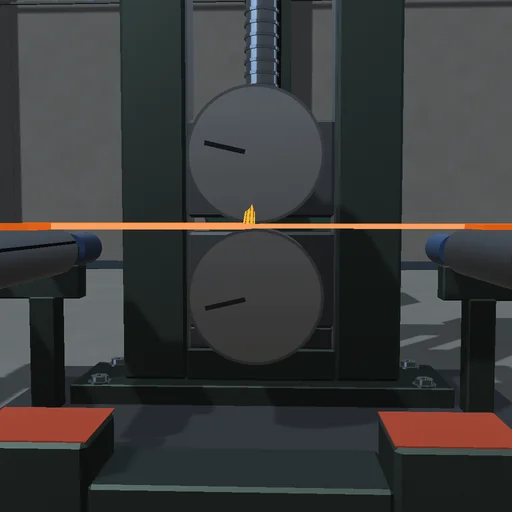
Inject molten plastic into the mold of a ruler and watch the two flow fronts run from the gate while a frozen skin grows from the cold steel. Move the gate, cool the mold, lower the pressure limit or slow the screw until the gate freezes shut and leaves a short shot, then hold, cool and eject the part.
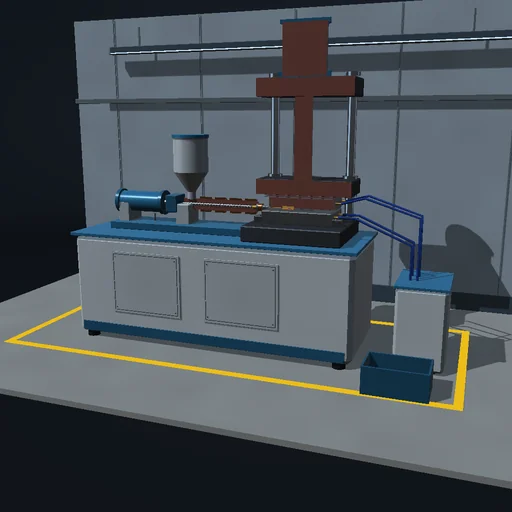
What happens
A vertical-clamp machine injects ABS into the mold of a ruler 300 mm long, 30 mm wide and 2 mm thick, through a tapered sprue, a runner and an edge gate 1.2 mm thick that sits in the middle of the ruler's long edge, a third of the way along or at its end. The channels are a network of cells: each passes a creeping flow by its conductance, Hele-Shaw in the slabs, Poiseuille in the round channels, with the viscosity of the hot core, 180 Pa·s at 240 °C. From the moment the melt touches the steel each cell cools by conduction across its thickness, and the layer below the no-flow temperature of 120 °C is a frozen skin that narrows the channel. The screw runs at the set speed up to its pressure limit; when the cavity is full the machine holds a packing pressure for 4 s, then the part cools and is ejected.
At 30 mm/s, with the gate a third along, both fronts advance together until the 100 mm branch is full at 1.22 s; then the 200 mm branch takes the whole flow, and the pressure at the end of filling is 79.7 MPa, against 39.0 MPa without a skin. With the gate in the middle both halves fill together at 53.7 MPa. Against the screw speed the pressure is a U: 67.5 MPa at 25 mm/s, 53.4 MPa at 35 mm/s, 87.8 MPa at 80 mm/s. The gate freezes shut 1.81 s after the melt passed it, so below 20.3 mm/s the ruler cannot be filled: at 20 mm/s it stops at 95.3 %. At the end, the gate on 40 MPa seals with the ruler 90.6 % full; a third along on 30 MPa leaves 4.7 % unfilled. A mold at 20 °C closes the gate after 1.50 s, and the end gate on 80 MPa stops at 98.2 %. Packed at 60 MPa until the gate seals, the ruler gated in the middle weighs 18.48 g and the whole shot 24.48 g; after 5 s of cooling its hottest core is at 76 °C, after 2 s at 105 °C, too soft to eject, and cold it measures 297.78 mm.
Model: a Newtonian melt, its core at the melt temperature; the skin grows as in melt at rest (exact slab conduction, the round channels taken as slabs of their diameter), so the model errs towards early freezing, and a fill stops only when a channel behind its front closes. The melt is incompressible while it flows; packing fills each open cell to ρ(T)·(1 + p/K), K = 1.7 GPa, and the shrinkage after the gate seals is indicated as isotropic. RK4 with steps of 1 ms; the screw's work equals the viscous dissipation plus the packing work, and the cells hold the mass the screw pushed.
Try this
Watch the two fronts run from the gate and the pressure climb as the skin grows; then move the gate to the end, lower the pressure limit or slow the screw until the gate freezes before the ruler is full.
Equations used in the module
Equations
Q = w·h_eff³·Δp/(12μ·L),  h_eff = h − 2δ
δ ≈ 2·erfinv(θ)·√(α·t),  θ = (T_nf − T_w)/(T_m − T_w)
μ = μ_ref·exp(E/R·(1/T − 1/T_ref))
m = V·ρ(T_mean)·(1 + p/K),  t < t_seal