Engineering
Metal rolling mill
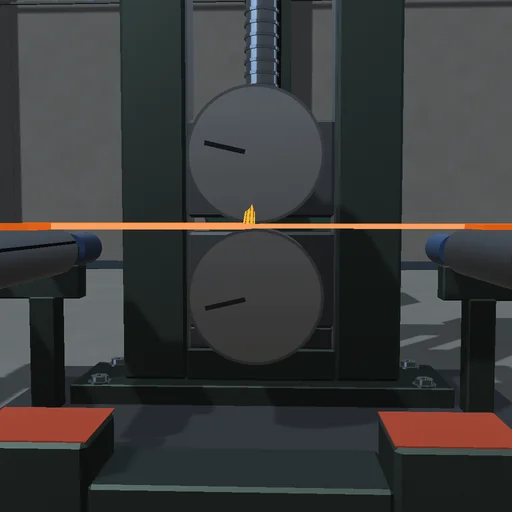
Roll a hot steel slab between two work rolls and watch the force, the torque and the stand's spring set the thickness that comes out. Close the gap until the drive stalls or the rolls refuse the slab, lubricate the rolls, cool the slab, and compare one heavy pass with two light ones.
What happens
A two-high reversing mill rolls a hot steel slab, 30 mm thick, 0.5 m wide and 2.5 m long, between work rolls of 0.3 m radius. The rolls draw the slab in only if friction wins at first contact: μ ≥ tan α, α being the bite angle. In the arc of contact the steel flows plastically at the flow stress of its temperature (2k = 138.6 MPa at 1000 °C); von Kármán's slab equation, integrated from the entry and from the exit, gives the friction hill of roll pressure and the neutral point, where the metal moves with the rolls. Its integrals give the roll force and torque, and the stand, stiff at 5 MN/mm, springs open by F/M. A speed-controlled motor with a torque limit turns the rolls through an inertia of 8000 kg·m².
Through a 20 mm gap dry rolls (μ 0.30) bite at 10.5° and roll the slab to 20.95 mm with 4.73 MN and 119 kN·m per roll; the neutral point lies at 3.48°, and the strip leaves 5.08 % faster than the roll surface, at 1.58 m/s against 1.10 m/s in. The head fills the arc in 34 ms while the drive dips by 3 %; of 1.19 MW of rolling, 822 kW is plastic work and 338 kW sliding friction. Lubricated rolls (μ 0.15) refuse this slab: they take at most 6.6 mm in one bite, dry ones 25.3 mm; at a 25 mm gap they need 2.70 MN against 3.02 MN dry. Closing the gap to 10 mm raises the force to 8.10 MN; at 8 mm the 600 kN·m drive stalls, and below 4.7 mm the slab is refused. A reversing schedule rolls the slab through the halfway gap first: it ends at 20.67 mm with at most 3.36 MN and about 7 % less rolling work, and it reaches 5.75 mm where one pass to a 4 mm gap cannot bite. At 800 °C the force grows to 9.20 MN.
Model: plane strain between rigid rolls (no flattening), no tensions, Coulomb friction capped at the shear yield stress k, a flow stress set by the temperature alone (no strain rate or hardening, no cooling during the passes). The head entering and the tail leaving are quasi-steady and tabulated over the metal in the arc when the slab is fed; the drive is integrated by RK4 with steps of 1 ms. The journal closes on the motor's work against plastic work, sliding friction, the shear of the surface layers, the roll-neck bearings and the kinetic energy of the drive and the slab; the slab's volume is kept exactly.
Try this
Watch the slab go through the rolls and read the force and the torque. Then close the gap, lubricate the rolls or cool the slab: find where the drive stalls and where the rolls refuse the slab, and compare one pass with two.
Equations used in the module
Equations
α = acos(1 − (h₀ − g)/(2R)),  μ ≥ tan α
dP/dθ = 2R·(sin θ − s·φ·cos θ)/h(θ),  φ = min(μP, ½),  P = p/2k,  s = sign(θ − φₙ)
F = w·R·∫(p·cos θ + s·τ·sin θ) dθ,  T = w·R²·∫s·τ dθ,  h₁ = g + F/M
Q = ω·R·h(φₙ)·cos φₙ = h₀·v₀ = h₁·v₁
J·dω/dt = T_motor − 2(T + μ_b·r_n·F)