Astronomy / Earth
Impact and the ejecta curtain
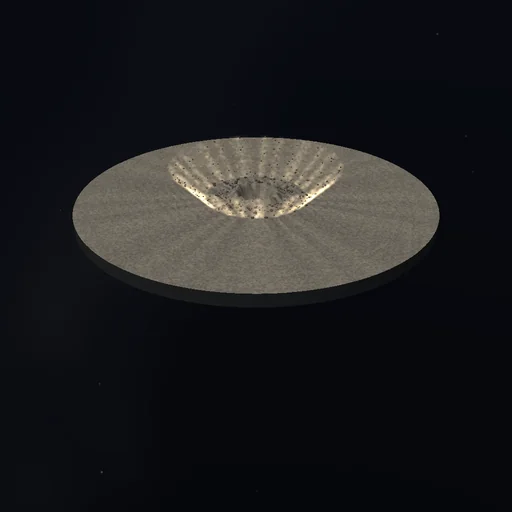
Choose the target body and the impactor. The atmosphere brakes, breaks or bursts it; the crater takes its scaled size and shape; the ejecta fly with the speeds of their launch positions, the fastest escaping small bodies.
The model and its limits
Collins, Melosh & Marcus (2005): exponential atmosphere, a single breakup and pancake, π-scaling in the gravity regime for rock; depths from the simple/complex fits. No oblique-impact asymmetry, no melt, no secondary craters, flat ground; ejecta at 45° with the Housen–Holsapple speed law for dry sand. The target density is the body’s mean density capped at crustal rock.
Equations used in the module
Equations
r = v cos θ t; h = v sin θ t - gt²/2; R(45°) = v²/g
D_tc = 1.161 (ρ_i/ρ_t)^(1/3) L^0.78 v^0.44 g^(−0.22) sin^(1/3) θ; v(z) = v₀ exp(−3 ρ(z) C_D H / (4 ρ_i L sin θ)); v_ej(x) = 0.55 √(gR) (x/R)^(−1/0.41)