Astronomy
Lagrange points
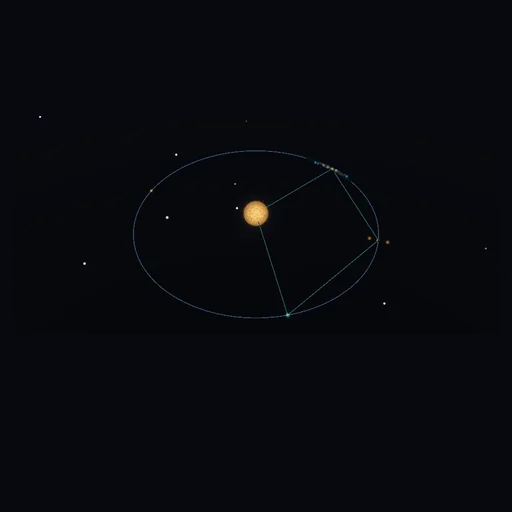
Explore Trojan orbits and unstable equilibria, open Jacobi necks and compare spatial trajectories in rotating and inertial frames.
What happens
Explore Trojan orbits and unstable equilibria, open Jacobi necks and compare spatial trajectories in rotating and inertial frames.
Circular restricted three-body problem in 3D: point-mass primaries, massless tracers, no mutual gravity, eccentricity or thrust. Units a=1, n=1, total mass=1; τ is not seconds. L4/L5 criterion is linear and local. Spatial presets are uncorrected centre/vertical-mode launches, not computed periodic halo orbits or a JWST ephemeris. Webb orbits around L2 and needs station keeping. Adaptive RK4 with step doubling and Richardson correction; stored accepted samples enable reproducible seek, no future data is measured. A 10^-4 a numerical close-approach guard, r>8a domain, drift or work limits stop a trace; none is proof of impact or permanent escape. Potential height, colours, glow, body/craft sizes and arrow lengths are illustrative. Map and relief use z=0 and the selected particle C; all ring members may have different C. A/B stores full experiments and compares common dimensionless epochs, not physical calendars. A trace also stops at 24,000 stored samples. Overview trails are clipped at |x| or |y| > 2.8a; the calculation continues up to its own domain limit. Close view focuses on at most 0.4a around the launch equilibrium. In relief mode B is projected onto the current experiment’s potential surface.
The model and its limits
Circular restricted three-body problem in 3D: point-mass primaries, massless tracers, no mutual gravity, eccentricity or thrust. Units a=1, n=1, total mass=1; τ is not seconds. L4/L5 criterion is linear and local. Spatial presets are uncorrected centre/vertical-mode launches, not computed periodic halo orbits or a JWST ephemeris. Webb orbits around L2 and needs station keeping. Adaptive RK4 with step doubling and Richardson correction; stored accepted samples enable reproducible seek, no future data is measured. A 10^-4 a numerical close-approach guard, r>8a domain, drift or work limits stop a trace; none is proof of impact or permanent escape. Potential height, colours, glow, body/craft sizes and arrow lengths are illustrative. Map and relief use z=0 and the selected particle C; all ring members may have different C. A/B stores full experiments and compares common dimensionless epochs, not physical calendars. A trace also stops at 24,000 stored samples. Overview trails are clipped at |x| or |y| > 2.8a; the calculation continues up to its own domain limit. Close view focuses on at most 0.4a around the launch equilibrium. In relief mode B is projected onto the current experiment’s potential surface.
Equations used in the module
Equations
Omega=(x²+y²)/2+(1-mu)/r1+mu/r2, r1²=(x+mu)²+y²+z², r2²=(x-1+mu)²+y²+z²
x''=Omega_x+2y', y''=Omega_y-2x', z''=-(1-mu)z/r1³-mu z/r2³
C=2Omega-vx²-vy²-vz²; allowed speeds require 2Omega-C>=0
L4/5=(1/2-mu, +/-sqrt(3)/2,0); linear planar stability: 27mu(1-mu)<1
lambda^4+(4-Omega_xx-Omega_yy)lambda²+Omega_xx Omega_yy-Omega_xy²=0
Inertial r=R(tau) r_rot; v=R(tau)(v_rot+ez cross r_rot)
One primary revolution = 2pi time units. C_i=2Omega(L_i); an open neck does not guarantee transit.