Astronomy / Earth
Tidal forces
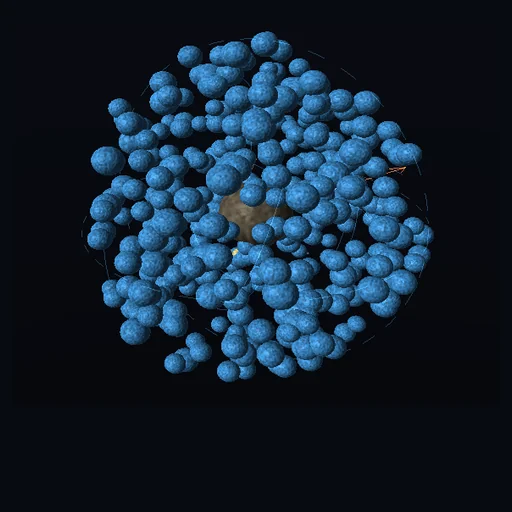
Explore tidal stretching in 3D: compare a satellite tracer cloud with an isolated control, inspect differential gravity, and distinguish a close passage from ideal Roche estimates.
What happens
Restricted Newtonian experiment: massless tracers in a fixed softened core potential, not a self-gravitating rubble pile. Circular initial orbits are stationary without tides; the speed control deliberately allows a cold collapsing cloud too. Spin changes orbital directions, not the initial positions. No mutual gravity, collisions, friction, fracture, fluid pressure or core mass loss. The core glyph is a potential marker, not a solid surface. The primary absorbs tracers crossing its reference radius; atmosphere and impact physics are absent. The satellite density sets the mass/radius and time scale; it is not a density inferred from real disruption. The planet texture and tracer sizes are illustrative. Energy is measured relative to the prescribed core and is not conserved during the tide. Negative energy at a finite endpoint is not proof of lasting capture. Roche circles are reference estimates, not this experiment’s measured breakup distance. No reconstruction of Shoemaker-Levy 9.
Equations used in the module
Equations
δg = −GM (R+x)/|R+x|³ + GM R/|R|³
δg_linear = GM/d³ [3n(n·x) − x]
a_core = −Gm x / (|x|²+ε²)^(3/2)
e_core = |v|²/2 − Gm/sqrt(|x|²+ε²)
d_balance = r_s (2M/m)^(1/3)
d_fluid = 2.44 r_s (M/m)^(1/3) [ideal circular synchronous orbit]