Physics
Pascal's law and communicating vessels
Force multiplied, work unchanged - and a base that cannot feel the shape above it.
What happens
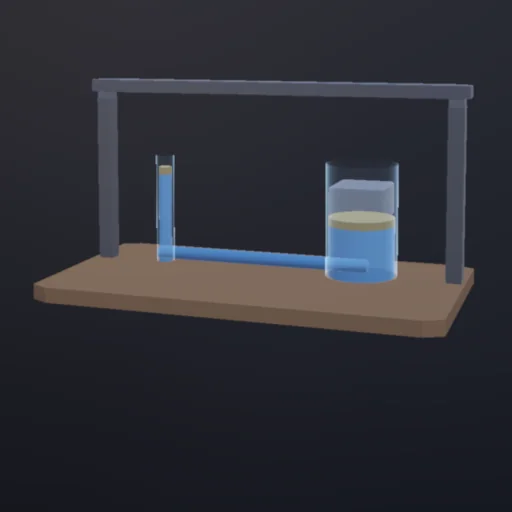
Press on a small piston and a large one lifts a car. The pressure is the same everywhere in the fluid, so F2/F1 = A2/A1 - but the small piston has to travel that many times further, and the work is identical on both sides to the last digit. A press is a lever, not a source. Next to it, four vessels of wildly different shape and volume come to exactly one level, because what drives flow is pressure and pressure depends on depth. A U-tube with two liquids does NOT level out: it balances at rho1 h1 = rho2 h2, which is how one density is measured against another. And the base of a vessel cannot feel the shape above it - a flaring jar holding six litres presses on its bottom exactly as hard as a narrow one holding barely one, at the same depth. The walls carry the difference, and the panel prints both numbers so the gap is visible rather than asserted. And Pascal's sphere makes the law itself visible: press the plunger and water squirts from every hole - up, sideways, down - at very nearly one speed, because the added pressure arrives at each hole undiminished. What little difference remains is gravity's rho-g-h, and it fades as the plunger presses harder.
Equations used in the module
Equations
p = F₁/A₁ = F₂/A₂
F₂ = F₁A₂/A₁; F₁d₁ = F₂d₂
ρ₁h₁ = ρ₂h₂
A(h) = [√A₀+(√A₁−√A₀)h/H]²
dV/dh = A(h)