MakarovSuites
English
EnglishDeutschРусскийУкраїнськаFrançaisEspañolItalianoPolski
Contact & licences

Math

Teleportation, and what the two classical bits are for

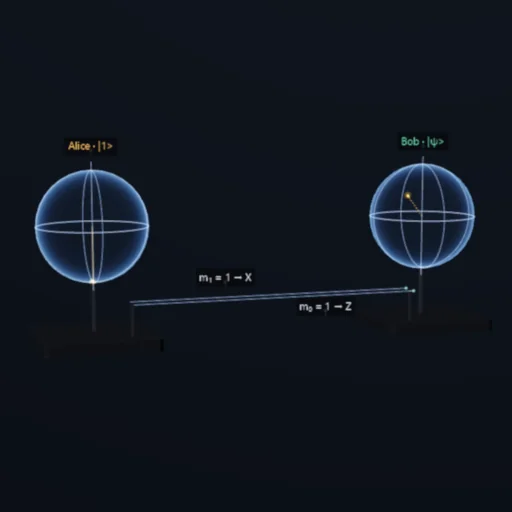
Alice's station holds a message qubit and half of a shared pair; Bob's holds the other half. Walk the protocol step by step - CNOT, H, measurement - and send the two bits down an ordinary channel. Stop them before they arrive and try to guess them; then pick Bob's correction and compare what he holds with the message. Until the bits arrive Bob's qubit is I/2 whatever was sent, and after measuring Alice keeps no copy.
Teleportation, and what the two classical bits are for — Actual application image
Actual application image

What happens

Alice holds a qubit in some state and half of an entangled pair; Bob holds the other half. She entangles her qubit with her half, measures both and gets two bits - each of the four results with probability exactly 1/4, whatever the state was. Bob's qubit is now the state up to one of four corrections, and the bits name which. Until they reach him, over an ordinary channel at an ordinary speed, his qubit by itself is I/2 - the centre of the sphere - for every message. Alice's qubits, once read, sit at the poles her bits name: the state was moved, not copied.

Equations used in the module
Equations
|ψ⟩ = cos(t/2)|0⟩ + e^{if} sin(t/2)|1⟩
shared pair: H, CNOT;  Alice: CNOT, H, measure two bits
Bob: X^{m₁} then Z^{m₀}  →  fidelity 1 for every outcome
without the bits: average fidelity ½, Bloch vector 0
Related experiments

Back to catalogue
One question, asked once — Actual application image

Math

One question, asked once

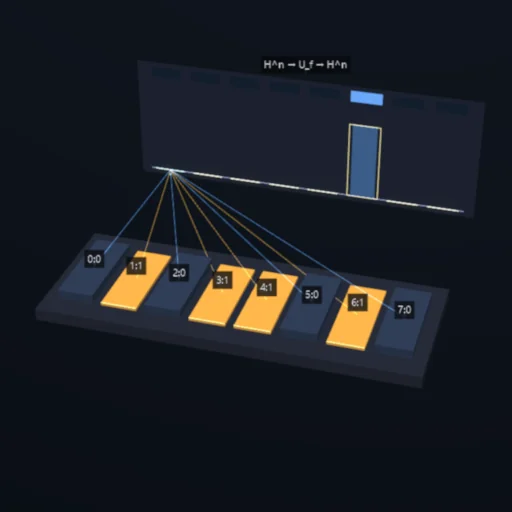
A black box computes f from n bits to one bit, and you may only ask it about inputs. To be certain whether f is constant or balanced can take half the table plus one call. Hadamard everything, ask ONCE with the answer as a sign, Hadamard everything again, and the all-zeros outcome settles it. The truth table here is clickable, so the promise can be broken by hand: for any table at all the answer comes up with probability (1 - 2k/N)². And when the table happens to be f(x) = s·x, the one call returns s itself.

Error-correcting codes — Actual application image

Math

Error-correcting codes

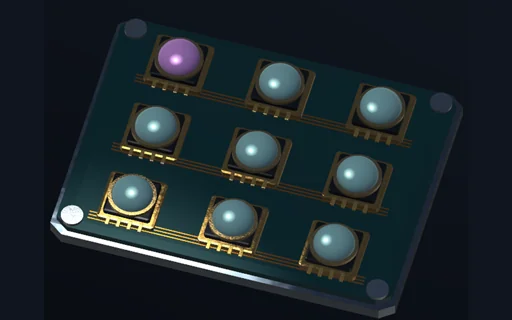
Inject X, Z or Y on a 3D code board, read the syndrome and reveal the recovery. Compare the remaining logical operator and input-state fidelity, then test exact probabilities against an ensemble of runs.

Euclid's algorithm and continued fractions — Actual application image

Math

Euclid's algorithm and continued fractions

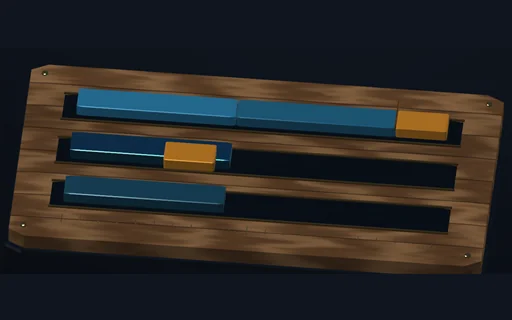
A brass-and-wood division bench shows why gcd(a,b)=gcd(b,r). Follow the remainder, inspect exact Bézout coefficients and continued fractions, compare pairs and explore a reproducible sample.