Math
Cellular automata
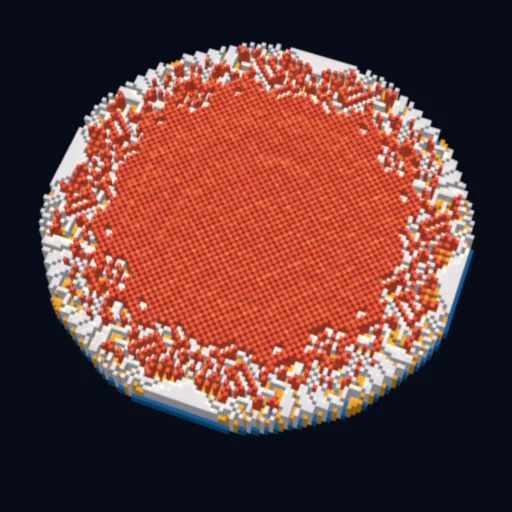
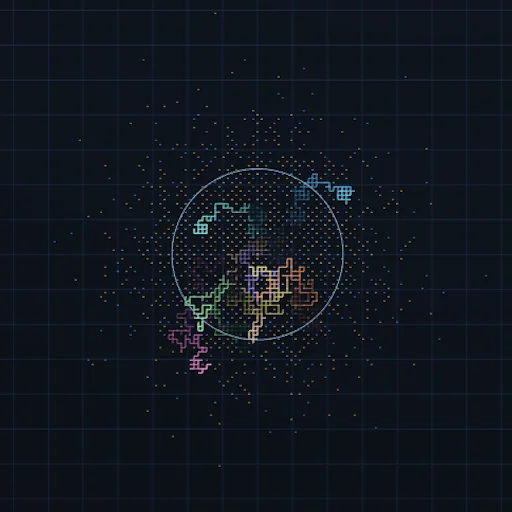
One rule, many cells: Wolfram's 256 elementary rules stacked into a sheet, Life's glider gun and R-pentomino with their worldlines beneath the plane, and the 3D stencil rules that stay alive.
What happens
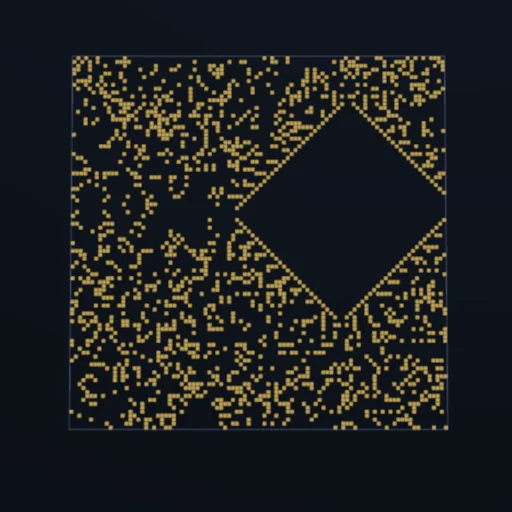
A row of cells, each looking only at its 2 neighbours and 1 rule of 8 bits - and rule 90 draws Sierpinski's triangle, rule 110 computes anything. Move up a dimension and Life's B3/S23 breeds gliders that walk and spaceships that fly; HighLife's one extra birth makes a replicator that copies itself every 12 generations. In a cube the same idea grows crystals and cores. Nothing here is designed: only the rule is chosen, and the rest emerges. Try the rules, count a glider's period, and watch the replicator double.
Equations used in the module
Equations
elementary: c_i(t+1) = rule bit (4c_{i−1} + 2c_i + c_{i+1})
Life B3/S23 on the Moore neighbourhood; glider period 4, shift (1, 1)
HighLife B36/S23: the replicator doubles every 12 generations
cube: born if the 26-count is in B, survives if in S