Physics
Coupled oscillators
Normal modes, beats and waves in a chain of 2–8 masses coupled by springs.
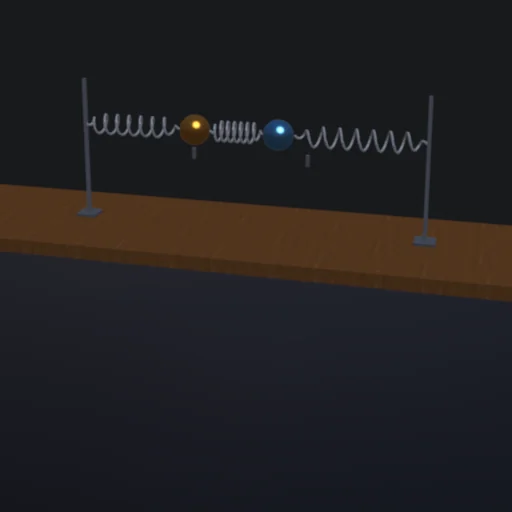
What happens
Masses joined by springs share their motion. The buttons launch the pure normal modes, where every mass oscillates at one common frequency, and the beats, where energy sloshes from one end of the chain to the other and back. Weaken the coupling and the beats slow down; the position chart makes it visible.
Equations used in the module
Equations
m x₁'' = −k x₁ − k_c(x₁−x₂)
m x_i'' = −k_c(2x_i−x_(i−1)−x_(i+1)), 1<i<N
m x_N'' = −k x_N − k_c(x_N−x_(N−1))
N = 2: ω₁ = √(k/m), ω₂ = √((k+2k_c)/m), T_b = 2π/|ω₂−ω₁|
k_c = k: ω_j = 2√(k/m) sin(jπ/(2(N+1)))