Engineering
Cycloidal reducer
Run a cycloidal reducer with one disc and then with two half a turn apart, and compare the force on the input bearing. Reverse under load with more play in the output pins: the input turns on while the output stands.
What happens
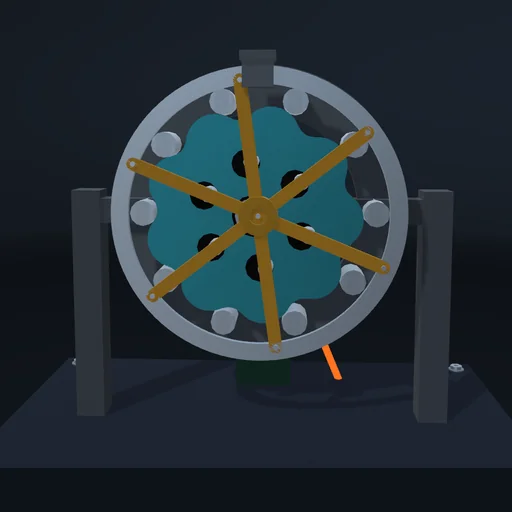
An eccentric on the input shaft carries a lobed disc inside a ring of N pins fixed in the housing. The disc has N − 1 lobes, so for every turn of the eccentric it rolls one lobe further round the pins and turns back by 1/(N − 1): with 10 pins the output turns −1/9 of the input, with 24 pins −1/23. Six pins of the output flange stand in holes of the disc and take up its turn while it wobbles. The disc’s centre circles at the input speed, so a single disc shakes the input bearing with a rotating force m·e·ω². A second disc half a turn round cancels that force, but the two discs lie in different planes and leave a rocking couple. Under the load L the input needs L/(N − 1), and the housing holds L·N/(N − 1). Reverse with play in the output pins: the input turns (N − 1) times the play before the output moves.
Model: rigid discs on their eccentrics; a disc rolling in the pins is one gear-like contact in the eccentric’s turning frame, and the output pins are a rotation coupling with play. No friction, pin contact forces or Hertz stresses; the drawn outline is the pins’ path relative to the disc, offset by the pin radius.
Try this
Compare the bearing force with one disc and with two; then raise the play, load the output and reverse.
Equations used in the module
Equations
ωo/ωi = −1/(N − 1)
F = m e ω²,  M = m e ω² Δz
Ti = L/(N − 1),  Th = L N/(N − 1)
Δθi = (N − 1) Δθp