Physics / Math
Deep zoom and the limits of precision
Zoom until the arithmetic gives out, then buy 22 more mantissa bits and watch the wall move.
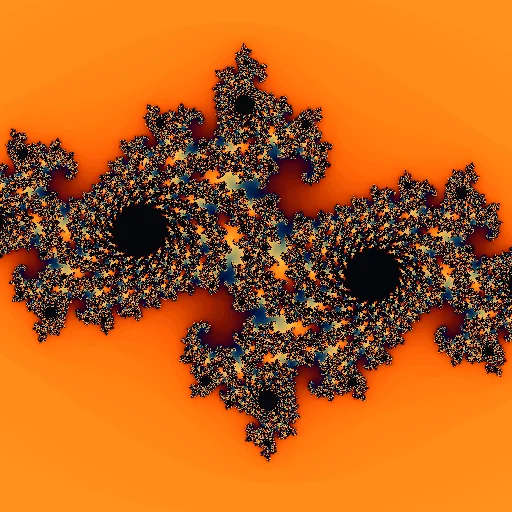
What happens
The Mandelbrot set used as a study of numerical precision. OpenGL 3.3 core promises only 32-bit floats in shaders, so a naive zoom dissolves into flat blocks near 1e5, where the pixel step falls below the spacing of representable numbers. Switch to double-float and every coordinate becomes an unevaluated sum of two floats, worth about 46 mantissa bits instead of 24, and the same wall moves out to about 1e12. The panel prints where the wall is and how much headroom is left, so the limit is a number rather than a surprise. The same arithmetic runs the Julia set, the Burning Ship, the Tricorn and the cubic Multibrot: switch the family and the wall stays where the mantissa puts it.
Equations used in the module
Equations
z_{n+1} = z_n² + c,   escape when |z_n| > 2
double precision ends near 1e-16 of the frame
perturbation: δ_{n+1} = 2 z_n δ_n + δ_n² + δc   (22 more bits)