Physics
Dzhanibekov effect
Spin about the middle axis and a free body flips - with no torque at all.
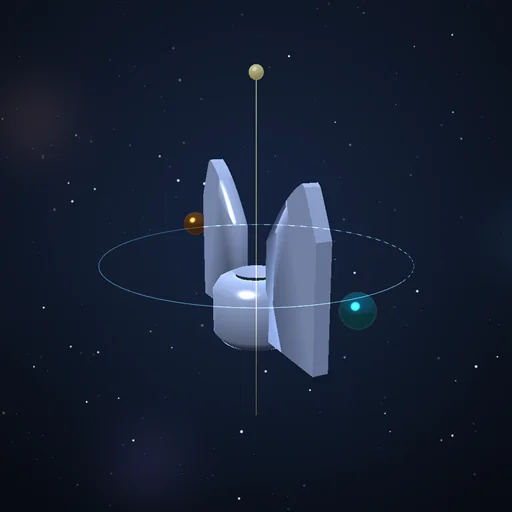
What happens
A wingnut spinning in weightlessness turns over, pauses, turns over again, forever. Nothing touches it. The whole thing follows from Euler's equations: a body has three principal axes, and rotation about the largest and smallest moments of inertia is stable while rotation about the middle one is not. A tiny sideways component grows exponentially at a rate sigma = w*sqrt((I2-I1)(I3-I2)/(I1 I3)), reaches the size of the spin, flips the body, and starts over. The yellow arrow is the angular momentum in space - watch it while the body tumbles: it does not move. That is the answer to 'what makes it flip'. Nothing does; conservation is what tumbling looks like when the spin axis is the middle one. The panel shows the drift of the two invariants so the integrator can be held to the same standard.
Equations used in the module
Equations
I₁ω₁' = (I₂−I₃)ω₂ω₃
I₂ω₂' = (I₃−I₁)ω₃ω₁; I₃ω₃' = (I₁−I₂)ω₁ω₂
I₁ < I₂ < I₃: σ = |ω₂|√((I₂−I₁)(I₃−I₂)/(I₁I₃))
E = ½Σ I_i ω_i² = const; |L|² = Σ I_i²ω_i² = const