Games
Fifteen puzzle
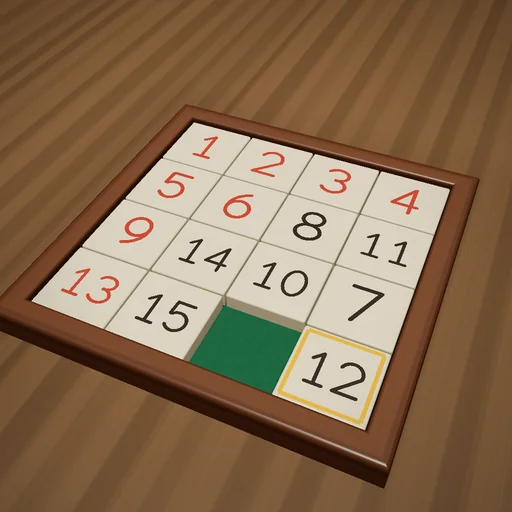
The fifteen puzzle: a tray of numbered ivory tiles with one cell empty - slide them until they stand in order. Play the classic 4 by 4 with fifteen tiles, the small 3 by 3 with eight or the large 5 by 5 with twenty-four; every shuffle can be solved. Click a tile to push it, and the tiles between, toward the gap, or use the arrow keys. The moves and the time are counted. Ask for a hint - the solver finds the shortest way on the small board and a short one on the larger - take moves back, or let the computer put the tiles in order.
What happens
The puzzle. A square tray holds numbered tiles and one empty cell. A tile next to the gap can slide into it; nothing else moves. The goal. Put the tiles in order, row by row from the top left, with the gap in the last cell. A tile that stands in its own cell wears a red number. Moves. Click a tile in the same row or column as the gap: it slides toward the gap together with the tiles between, and each tile counts as one move. The arrow keys slide a single tile. Shuffles. Exactly half of all arrangements can be put in order; the others cannot, however long one tries - exchange two tiles of the ordered board and it becomes one of them. Every shuffle here is one that can be solved. Hint. The hint marks the next tile of a solution. On the 3 by 3 board that solution is the shortest there is; on the larger boards it is short, and the shortest when the search could prove it.
Try this
Click a tile in line with the gap to slide it. The right mouse button turns the view, the wheel zooms.