Math
Morley's miracle
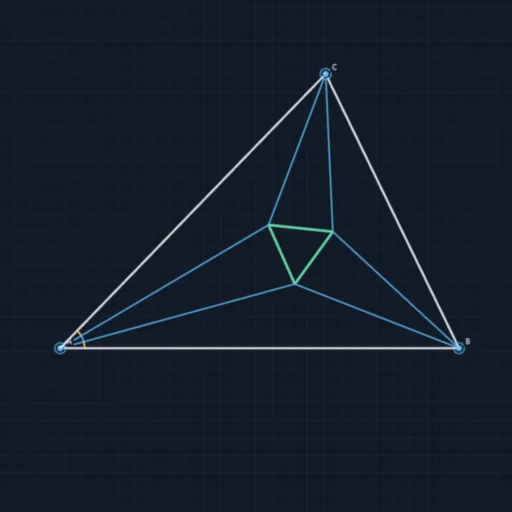
Trisect every angle of any triangle: the trisectors next to each side meet in three points, and those three points always make an equilateral triangle - measured live as three equal sides and three 60° angles, on a lopsided triangle as on a square one; turn the cuts away from thirds with a slider and it stops being true at once, and the task is to find the third by hand.
What happens
Take any triangle - lopsided, squat, whatever you drag it into - and cut each of its three angles into three equal parts. Next to each side, two of those cuts meet in a point. Morley found in 1899 that the three points always form an equilateral triangle, no matter what the outer one looks like, and the result surprised everyone because nothing of the kind is true for bisectors, and nothing in the Greek toolkit gets near it. Here the three points are built exactly that way - rays turned by a third of each angle, intersected - and the inner triangle is measured, not drawn: its three sides and three angles are printed to the last digit, and they read equal and 60° on every triangle you make. The slider turns the cuts into any other fraction of the angles, and the theorem stops at once: at 0.3 the sides already differ, at a half the three points collapse onto one. The whole miracle lives in the number one third, and the task is to find it with the slider.
Equations used in the module
Equations
Morley (1899):  in any triangle the pairs of angle trisectors adjacent to each side meet in three points that form an equilateral triangle
side of the Morley triangle:  8R · sin(A/3) · sin(B/3) · sin(C/3), R the circumradius - 0.418917 on the opening triangle
measured here:  the three points from rays turned by f·A, f·B, f·C into the triangle, intersected; three sides and three angles printed; equilateral to 1e-16 at f = 1/3 and at no other f
why bisectors will not do:  at f = 1/2 all three rays meet at one point, the incentre - the triangle collapses
why the theorem is a miracle:  a first-order change in f gives a first-order change in the shape (f = 0.3: sides differ by 2e-3, angles off 60° by 0.26°), so the exact third is the only value that works