MakarovSuites
English
EnglishDeutschРусскийУкраїнськаFrançaisEspañolItalianoPolski
Contact & licences

Earth

Ocean carbonate chemistry

Bubble air of a chosen CO2 through a beaker of seawater on a laboratory bench and watch the indicator change colour. The water’s dissolved carbon and alkalinity fix its pH and the shares of dissolved CO2, bicarbonate and carbonate ion, with the published constants of Lueker, Dickson, Millero, Weiss and Mucci; the Revelle factor says why the water’s CO2 pressure rises ten times faster than its carbon. Raise the air’s CO2 and the carbonate ion falls until, near four thousand micro-atmospheres, the water can no longer keep aragonite: the shell on the bottom begins to dissolve, and its two units of alkalinity for every carbon buffer the water back to just under saturation. Cold water of the same chemistry holds less carbonate. Carbon in water, shell and air is conserved to rounding.
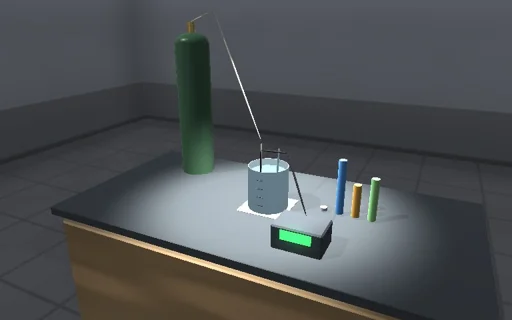
Ocean carbonate chemistry — Actual application image
Actual application image

What happens

A kilogram of seawater with 2300 µmol/kg of alkalinity and 2000 of dissolved inorganic carbon at 25 °C and salinity 35. The pH on the total scale solves TA = DIC (K1 h + 2 K1 K2)/(h² + K1 h + K1 K2) + B_T K_B/(K_B + h) + K_w/h − h by bisection, with K1 and K2 of Lueker et al. (2000), K_B of Dickson (1990), Uppström’s boron, K_w of Millero (1995), K0 of Weiss (1974) and the aragonite product of Mucci (1983). Gas exchange relaxes the dissolved CO2 to K0 pCO2_air; a shell of 2 g of aragonite dissolves at k (1 − Omega)^1.5 when Omega < 1, adding one carbon and two alkalinity per unit. RK4 at 1 min.

Try this

Raise the air’s CO2 and watch the indicator turn; compare the carbonate ion at two temperatures; push the water past saturation and watch the shell dissolve and buffer it; read the Revelle factor.

The model and its limits

Equilibrium chemistry with published constants at one atmosphere, no nutrients, organic matter or calcite, a single exchange time, a lumped dissolution law. Values belong to this idealized beaker.

Equations used in the module
Equations
TA = DIC·(K1·h + 2K1·K2)/(h² + K1·h + K1·K2) + B_T·K_B/(K_B + h) + K_w/h − h
pCO2 = [CO2]/K0,  Ω = [Ca]·[CO3]/K_sp
dDIC/dt = (K0·pCO2_air − [CO2])/τ + R,  dTA/dt = 2R
R = k·(m/m0)^(2/3)·(1 − Ω)^1.5 for Ω < 1,  Revelle = (dp/p)/(dDIC/DIC)
Related experiments

Back to catalogue
Air pollution dispersion — Actual application image

Earth

Air pollution dispersion

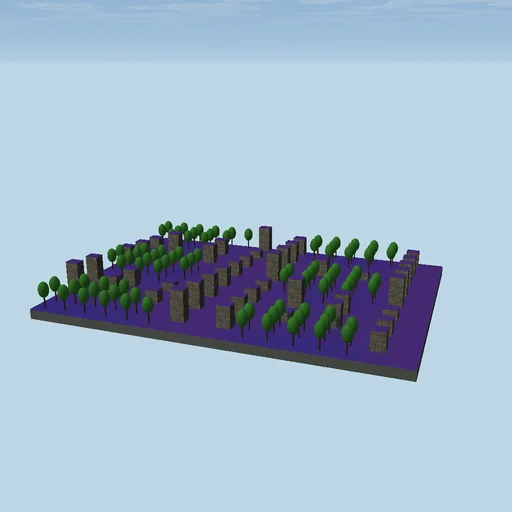
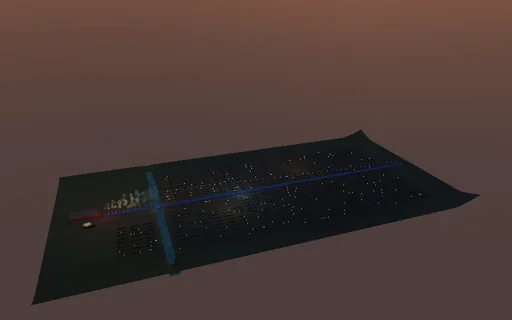
Watch the smoke of a brick factory chimney drift over a terraced town at dawn. The hot exhaust rises by Briggs’s plume rise, then the wind carries it downwind while the turbulence of the chosen Pasquill class mixes it towards the ground: in a sunny unstable morning it loops down within a few hundred metres, in a neutral one it touches the town a couple of kilometres away, in a calm stable night it fans out aloft and barely reaches the roofs. Let an inversion lid trap it over the houses, or set the lid below the plume and the town stays clean. A ribbon over the roofs draws the ground-level concentration beside the Gaussian plume, a station reads it; with a uniform wind and a constant K the slab settles onto the exact steady plume, its ground maximum 2Q/(eπuH²). Stop the source and watch what is left blow out of the valley; the emitted mass always equals what is in the air, deposited and gone.

Vegetation, water and climate — Actual application image

Earth

Vegetation, water and climate

Walk around a little planet covered with daisies as its sun grows brighter. Black daisies absorb sunlight and warm themselves and the planet, white ones reflect it and keep cool; both grow best at 22.5 °C. So the faint young sun is met by black daisies, the bright old one by white ones, and in between both together hold the planet within a few degrees of the optimum while the bare planet would warm by forty - the closed-form coexistence branch on the board, its local temperatures exactly 5 K either side of the optimum. Push the sun past 1.54 and the whites collapse in one jump; dim it again and they return only at 1.22 - sweep and watch the hysteresis drawn. Switch to the desert: plants bring their own rain, and at the same rainfall a green savanna and a bare desert are both stable, until a drought tips the green one over for good. Areas are booked to round-off.