Math
Percolation
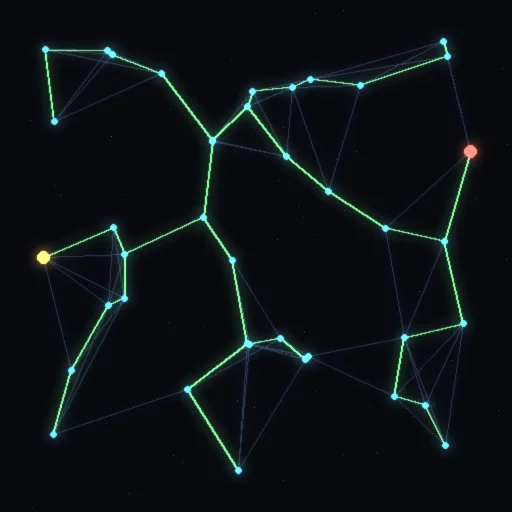
An inlet, an outlet and one sample of a random lattice: predict at which p this sample first lets a flood through, raise p or open single sites by hand, and watch the reachable region spread - then run many samples at several sizes and see the crossing point spread out around p_c and narrow as the lattice grows.
What happens
Open sites (or bonds) at random with probability p, and ask whether anything connects the left side of the grid to the right. Below a threshold nothing does; above it, almost surely something does - and the change is sharp. On this page one sample is taken seriously: a flood spreads from the inlet through what is open, the passage opens the moment it touches the outlet, and that moment has its own p for every sample. Predict it, raise p, open single sites by hand; then run hundreds of samples at several sizes. Their crossing points scatter around p_c = 0.5927 for sites and 1/2 for bonds, and the scatter narrows as the lattice grows - p_c is where it would close for an infinite lattice.
Equations used in the module
Equations
a site is open with probability p; open neighbours join one cluster
1D chain:  P(span) = p^L exactly
2D square, sites:  p_c = 0.592746 (measured);  bonds:  p_c = 1/2 EXACTLY - self-duality
duality:  the dual lattice crosses exactly when the primal does not, so an (L+1) x L rectangle of sites crosses at p = 1/2 with probability 1/2 for every L
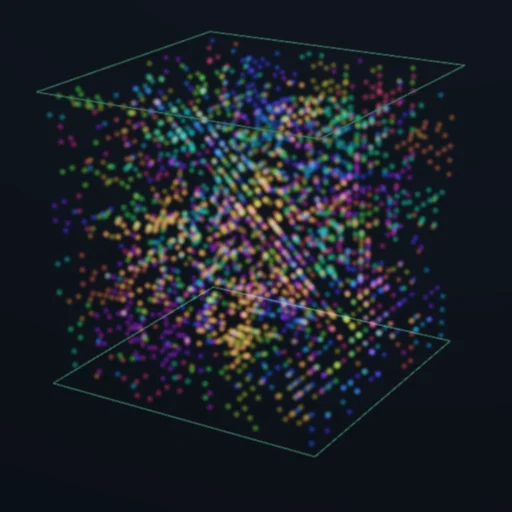
3D cubic, sites:  p_c = 0.3116
giant cluster:  below p_c the largest cluster is local; above it, a finite fraction of the whole grid