Physics
Quadcopter and control
Four rotors, a cascaded controller and gains you can break: fly a course or catch a shove.
What happens
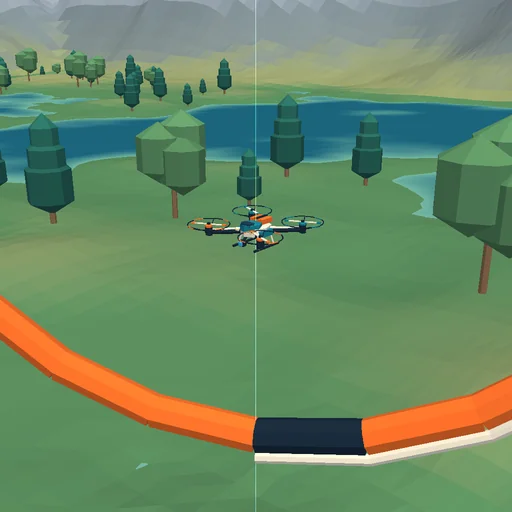
A quadrotor with the model flight controllers actually use. Roll and pitch come from differential thrust across the frame, yaw from the imbalance of the rotor reaction torques. Attitude is carried as a quaternion and integrated from the body rates, and Euler's equations keep the gyroscopic coupling that makes a fast yaw bleed into roll. The controller is the usual cascade: a slow loop turns a position error into a lean, a fast loop turns the attitude error into four thrusts. Both sets of gains are sliders, because the point is that you can make it unstable and watch exactly how. The course now runs over a living landscape: hills, lakes, low-poly forests and snow-capped mountains on the horizon. The gates stand on the actual terrain, the crash floor IS the hillside under the craft, and the grey plumb line shows the height above the ground actually below you.
Equations used in the module
Equations
T_i = k_T ω_i²
m a = R(0,ΣT_i,0) + (0,−mg,0) + F_drag
I dω/dt = τ − ω × (Iω)
u = K_p e + K_i ∫e dt + K_d de/dt