Engineering
Soft pneumatic gripper
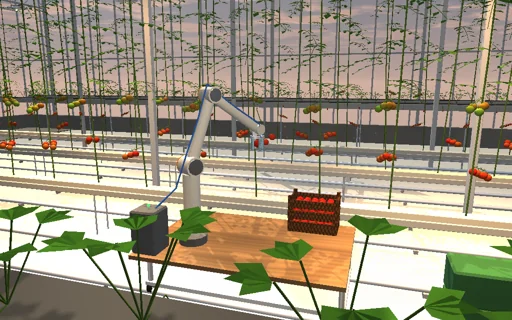
Pick a tomato in a sunlit glasshouse with a gripper of four translucent silicone fingers. Air through the valve fills their chambers with the time constant of an RC circuit, the pressure bends every finger with constant curvature M/EI, and where a finger meets the soft fruit the contact follows Hertz: F = 4/3 E* sqrt(R) δ^1.5, with a peak pressure that must stay below the fruit’s bruise threshold. Lift, and the fruit stays only while friction and the cradling fingers carry its weight and the lift’s acceleration. Find the smallest pressure that holds, make the skin wet and watch the tomato slip, then try a strawberry the same pressure bruises; every joule the air does is followed into the bent silicone, the dents and the losses.
What happens
Four PneuNet fingers, 96 mm long, hang from the palm at 46 mm radius; by symmetry the fruit sits on the axis and one finger is computed, the totals four times its own. A finger is eight segments of 12 mm: each joint has the bending stiffness k = EI/l = 0.1 N·m/rad (EI = 1.2×0.001 N·m²), a viscous loss c = 0.15 s·k and the chambers’ moment M = p·A·e with A·e = 0.78 cm³ - the volume each joint adds per radian, so M·dφ is the p·dV work. Without contact every joint turns M·l/EI: constant curvature κ = M/EI. The fingers are overdamped, c·dφ/dt = M − k·φ + Q. The pressure follows the valve, dp/dt = (p_s − p)/τ with τ = 0.25 s, exact over each step. The pad, 8 mm from the centre line, indents the fruit (a sphere) by δ = R + t − d; Hertz gives F = 4/3·E*·√R·δ^1.5 with 1/E* = (1 − ν_f²)/E_f + (1 − ν_s²)/E_s, the peak pressure p0 = (2E*/π)·√(δ/R) and the contact radius √(R·δ); Q is the force’s virtual work on the joints. Neighbouring fingertips press on each other once they meet near the axis. Tomato: R = 32 mm, 140 g, E = 0.45 MPa, bruise 28 kPa; cherry tomato 14 mm, 12 g, 45 kPa; strawberry 17 mm, 20 g, 0.12 MPa, 14 kPa; silicone 0.8 MPa. The arm descends, the valve opens at 1 s, at 3 s the arm lifts the fruit off its stem 15 cm, carries it 0.5 m to the crate and the valve vents. From the lift the fruit stays while 4·ΣF·(e_z + μ·|e_h|) ≥ m·(g + a_z), μ = 0.9 dry, 0.3 wet; otherwise it slips - off the fingers on the plant, or out of the hand, falling to the crate or the floor. RK4 in 0.1 ms steps, refined where a contact starts; pneumatic work = elastic + contact + dissipation + released contact energy to 10^-9 J. Newton’s method gives the static grasp, bisection on it the pressure window.
Try this
Watch the fingers close and the dents appear; read the hold margin before the lift and see the tomato carried to the crate; set the skin wet and it slips as the lift starts; press “Use the minimum” and the grip just holds; pick the strawberry and the same 32 kPa bruises it; take the fruit away and the fingertips meet.
The model and its limits
Fingers as overdamped chains of rigid segments with linear joints instead of a nonlinear silicone FEM; no finger inertia; the fruit a sphere centred on the axis, Hertz contact per segment without friction loading the fingers or slip before the threshold; the stem’s pull and the carry’s horizontal acceleration are not modelled; the bruise thresholds are illustrative. The dents are drawn four times deeper than they are.
Equations used in the module
Equations
M = p·A·e,  c·dφ_j/dt = M − k·φ_j + Q_j,  k = EI/l  (free: κ = M/EI)
dp/dt = (p_s − p)/τ,  p(t) = p_s·(1 − e^(−t/τ))
F = 4/3·E*·√R·δ^1.5,  p0 = (2E*/π)·√(δ/R),  4·ΣF·(e_z + μ·|e_h|) ≥ m·(g + a_z)
∫p·dV = ½k·Σφ² + 2/5·ΣF·δ + ∫c·Σ(dφ/dt)²·dt + E_released