MakarovSuites
English
EnglishDeutschРусскийУкраїнськаFrançaisEspañolItalianoPolski
Contact & licences

Math

The birth of the giant component

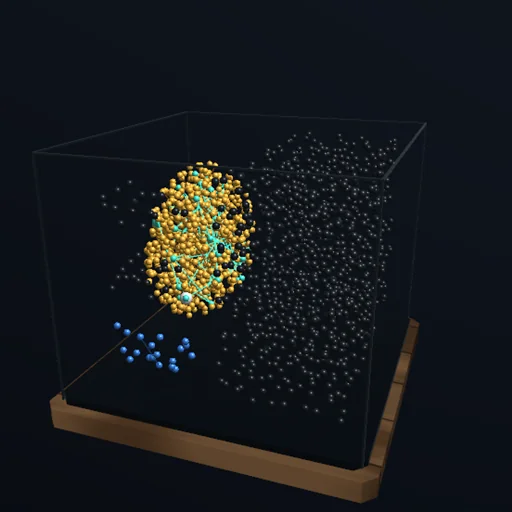
Add one edge, find a path between two vertices, then watch c pass through one. The graph and all readings use the same edge stream.
The birth of the giant component — Actual application image
Actual application image

What happens

Add one edge, find a path between two vertices, then watch c pass through one. The graph and all readings use the same edge stream. Uniform random unordered pairs of distinct vertices, sampled with replacement. Loops are excluded; repeated pairs count in E. This is a multigraph, not a simple G(N,E) sample. The curve S = 1 − exp(−cS) is a sparse large-N limit: c = 2E/N, so c = 1 means E ≈ N/2. A finite graph has no prescribed transition edge. Real networks need their own models.

Equations used in the module
Equations
c = 2E/N
S = 0 (c ≤ 1); S = 1 − exp(−cS) (c > 1), N → ∞
L₁/N; L₂/N
d(A,B) = min |P(A,B)|
Related experiments

Back to catalogue
Mathematical billiards — Actual application image

Math

Mathematical billiards

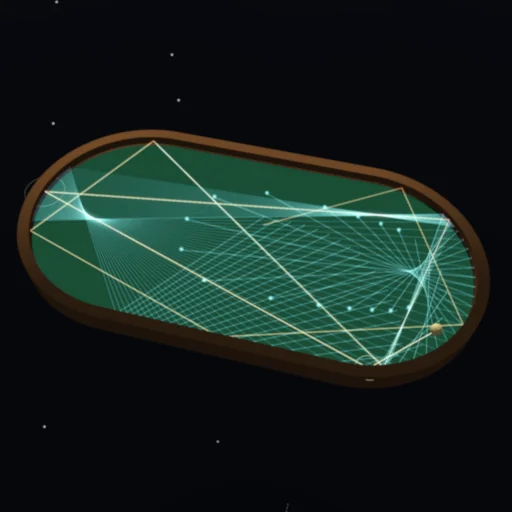
A point bouncing inside a wall with equal angles, for ever. Inside a circle the angle never changes: the path avoids a smaller circle it can never enter, and a rational rotation closes into a polygon. Inside a stadium - two half-circles joined by straight walls - nothing is conserved but the speed, and two paths a billionth of a degree apart are a table's width apart after twenty bounces. The panel measures that: the separation is fitted against an exponential AND against a straight line, and which one fits is the answer.

Why a computed trajectory lies — Actual application image

Math

Why a computed trajectory lies

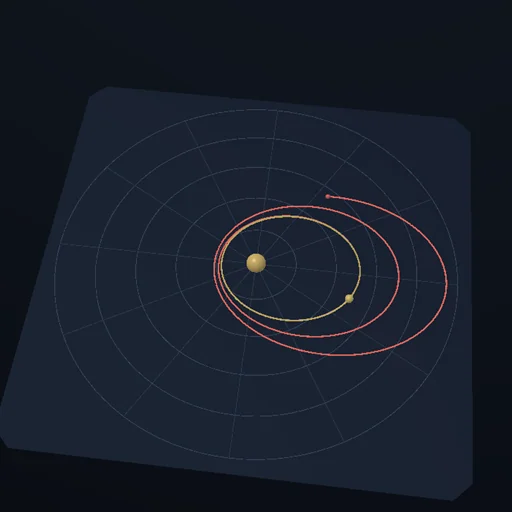
A computer cannot follow a trajectory; it can only take steps. Halving the step divides the error by two, four or sixteen depending on the method - until so many steps accumulate round-off that a smaller step makes the answer WORSE. On an orbit the most accurate method of the four still loses energy in a straight line while a less accurate one merely wobbles for ever, because accuracy and respect for an invariant are different virtues. And in a chaotic system the path is doomed whatever the method: what survives is the attractor, not the trajectory.

Length and area are not what a shape looks like — Actual application image

Math

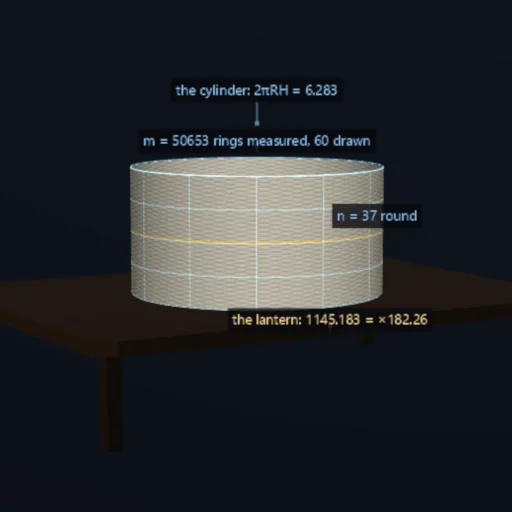
Length and area are not what a shape looks like

An approximation can hug a curve as closely as you please and still have the wrong length: a staircase converging to a diagonal is 41 % too long at every refinement, for ever. One dimension up it is worse. Schwarz's lantern has every vertex on a cylinder and triangles as small as you like, and its total area tends to the true 2π, or to five times that, or to infinity - depending only on how its two refinements race each other. What decides is not the size of the pieces but their tilt, and the panel measures it.