Math
Why a computed trajectory lies
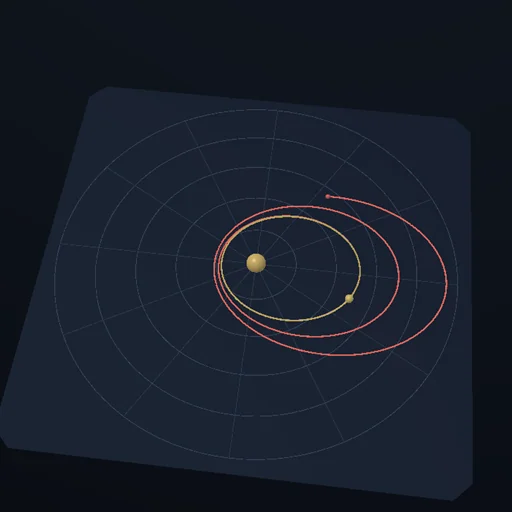
A computer cannot follow a trajectory; it can only take steps. Halving the step divides the error by two, four or sixteen depending on the method - until so many steps accumulate round-off that a smaller step makes the answer WORSE. On an orbit the most accurate method of the four still loses energy in a straight line while a less accurate one merely wobbles for ever, because accuracy and respect for an invariant are different virtues. And in a chaotic system the path is doomed whatever the method: what survives is the attractor, not the trajectory.
What happens
A computer cannot follow a trajectory; it can take a step, look at the forces where it landed, and take another. Everything that goes wrong afterwards comes from that. Euler's step spirals an oscillator outward, gaining energy it has no right to; swap the order of two lines and the same first-order method keeps the energy bounded for ever - that is what symplectic means. Verlet is second order and symplectic, the planets' integrator; Runge-Kutta 4 is far more accurate per step and still drifts, slowly. Halve the step and read the measured order; then run the Lorenz attractor and watch two methods part company at the same time.
Equations used in the module
Equations
Euler: y' = y + h f(y), order 1, energy drifts
symplectic Euler: q' = q + hv, v' = v + h a(q'), order 1, energy bounded
velocity Verlet: order 2, symplectic
Runge-Kutta 4: order 4, energy drifts slowly