MakarovSuites
English
EnglishDeutschРусскийУкраїнськаFrançaisEspañolItalianoPolski
Contact & licences

Math

Wallpaper groups and Penrose

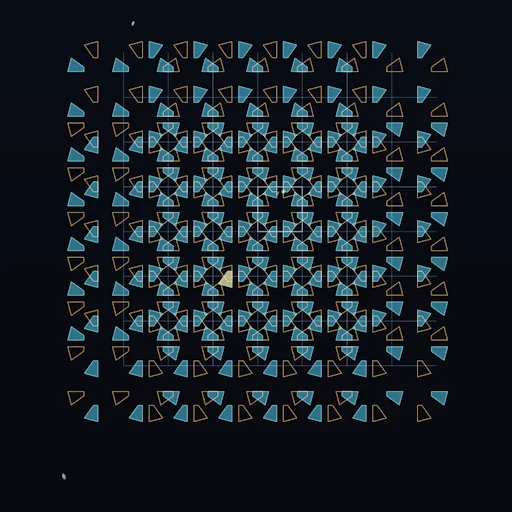
The seventeen wallpaper groups, each built from one or two generators and applied to a motif you drag; mirrored copies in a second colour, so rotations, reflections and glides can be told apart by eye. The group's order, its rotations and its mirrors read off the elements, not off the name. And the eighteenth pattern - Penrose rhombi - with thick and thin counts walking to the golden ratio.
Wallpaper groups and Penrose — Actual application image
Actual application image

What happens

A wallpaper is a pattern that can be slid onto itself along a lattice, and perhaps turned, reflected, or reflected-and-slid. There are exactly seventeen ways to combine those in the plane, and this module builds each group from its generators and stamps one motif through it. The motif is asymmetric on purpose: its copies show where the mirrors and rotation centres are, and whether the glides are true glides. Two groups with the same rotations differ only in where their mirrors run - p3m1 and p31m - and the stabiliser of one point tells them apart. Pick a group, count the copies in a cell, and find the mirrors.

Equations used in the module
Equations
element (M, t): M an integer 2×2 matrix, t a translation mod the lattice
group = closure of the generators;  orders of p1 … p6m: 1, 2, 2, 2, 2, 4, 4, 4, 4, 6, 8, 8, 8, 12, 3, 6, 12
mirror: det M = −1 with (I + M)(t + n) in 2Z² for some integer n
p3m1 vs p31m: the stabiliser of (1/3, 2/3) has order 6 vs 3
Related experiments

Back to catalogue
Why the bell appears — Actual application image

Math

Why the bell appears

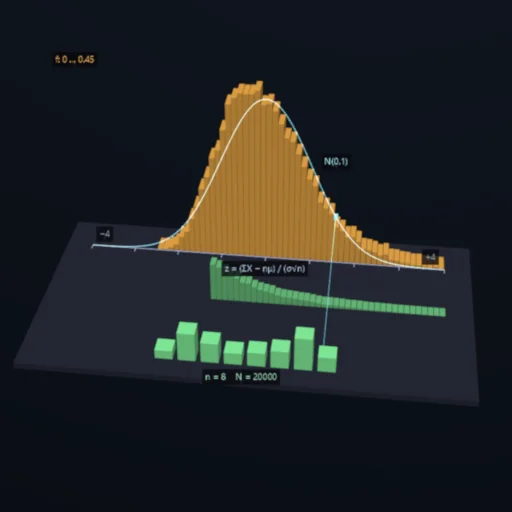
Add up draws from any shape - a die, a loaded coin, two humps, the long tail of a waiting time - and the standardised sum turns into the same bell. One sample is collected before your eyes and becomes one point of the series beside it; the sum, the mean and the standardised sum are three names of that point. Cumulants of a sum add, so the skewness falls as 1/√n and the excess kurtosis as 1/n, and the sheet measures both. And one source breaks it: a Cauchy has no variance, and no bell ever appears.

The average settles, the count does not — Actual application image

Math

The average settles, the count does not

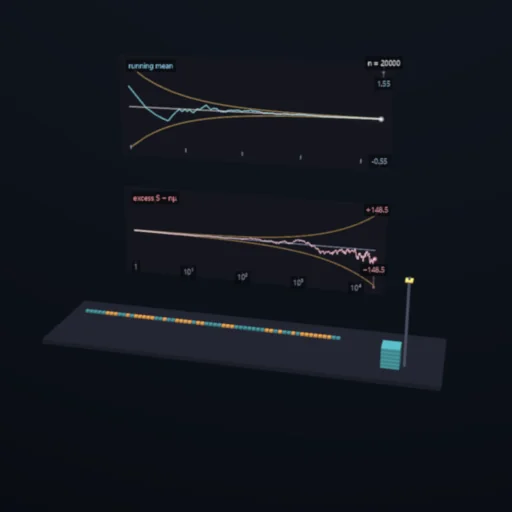
A chain you can read - outcome, sum, mean - and two charts on one log-n axis with one cursor: the mean's deviation walks into a funnel of ±2σ/√n, while the excess count S_n − nμ grows like √n and never settles. Predict first whether the excess goes to zero too, then let the run climb; six other runs under the same conditions stand beside it. A forced streak is forgotten by the mean and kept by the count; for the coin the numbers are exact from the binomial; and a Cauchy source, which has no mean, never settles at all.

Ninety-five times out of a hundred — Actual application image

Math

Ninety-five times out of a hundred

Inspect the observations behind a confidence interval. Repeat the experiment and compare coverage and width of methods on the same samples.