MakarovSuites
English
EnglishDeutschРусскийУкраїнськаFrançaisEspañolItalianoPolski
Contact & licences

Math

Length and area are not what a shape looks like

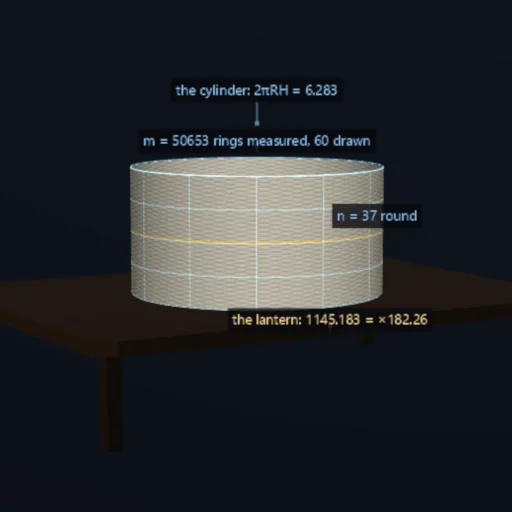
An approximation can hug a curve as closely as you please and still have the wrong length: a staircase converging to a diagonal is 41 % too long at every refinement, for ever. One dimension up it is worse. Schwarz's lantern has every vertex on a cylinder and triangles as small as you like, and its total area tends to the true 2π, or to five times that, or to infinity - depending only on how its two refinements race each other. What decides is not the size of the pieces but their tilt, and the panel measures it.
Length and area are not what a shape looks like — Actual application image
Actual application image

What happens

The length of a curve is the limit of inscribed polygons - for the circle that works, and each doubling of the sides cuts the deficit by four. But a staircase drawn ever finer along a diagonal keeps its length 2 while it hugs a diagonal of length √2: the polygon must have short sides AND small angles. Area is worse. Schwarz's lantern inscribes triangles in a cylinder, and depending on how you refine it the total area converges to the cylinder's, to something larger, or to infinity - the triangles fold like a paper lantern. Refine the lantern along both knobs and watch where the area goes.

Equations used in the module
Equations
inscribed n-gon: L = 2nR sin(π/n) → 2πR, deficit ~ π³R/3n²
staircase to a diagonal: length 2 for every n, though the distance → 0
Schwarz's lantern, m rings × n sectors: A = 2mnR sin(π/n) √((H/m)² + R²(1 − cos π/n)²)
m = n: A → 2πRH;  m = n³: A → ∞
Related experiments

Back to catalogue
The precision race — Actual application image

Math

The precision race

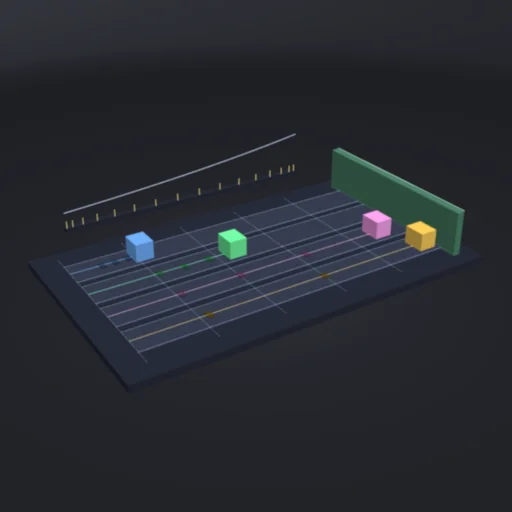
Accuracy is bought with work, and the exchange rate is not a property of the method. Four rules integrate the same function and the currency is how many times the function is read: the race is run on a chart of error against evaluations with a tolerance line you set, after you predict the winner. On a smooth function Gauss reaches machine precision in eight readings where the trapezoid rule needs sixty-five thousand; put one kink in the function and every high-order rule collapses to the same crawl. And past ten million terms the additions themselves lose six digits.

Wallpaper groups and Penrose — Actual application image

Math

Wallpaper groups and Penrose

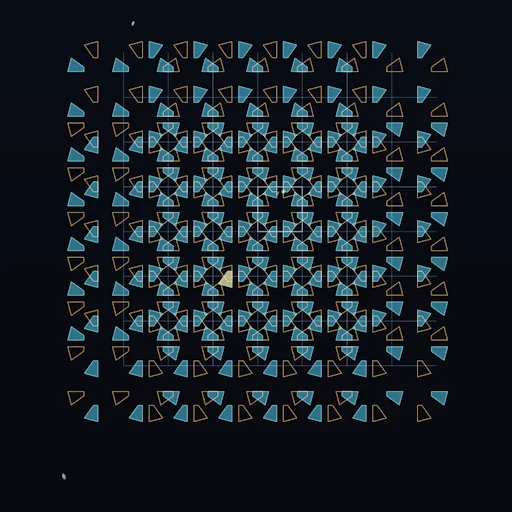
The seventeen wallpaper groups, each built from one or two generators and applied to a motif you drag; mirrored copies in a second colour, so rotations, reflections and glides can be told apart by eye. The group's order, its rotations and its mirrors read off the elements, not off the name. And the eighteenth pattern - Penrose rhombi - with thick and thin counts walking to the golden ratio.

Why the bell appears — Actual application image

Math

Why the bell appears

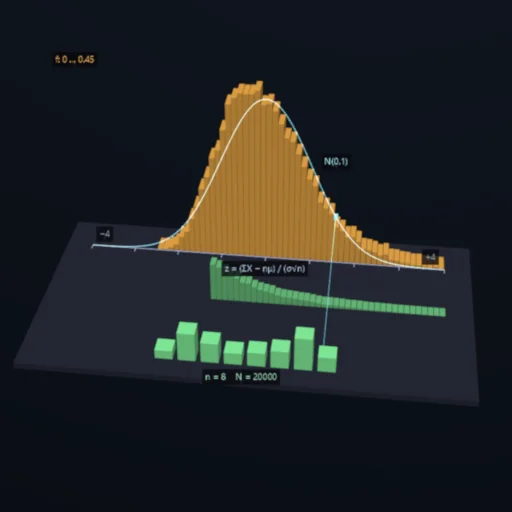
Add up draws from any shape - a die, a loaded coin, two humps, the long tail of a waiting time - and the standardised sum turns into the same bell. One sample is collected before your eyes and becomes one point of the series beside it; the sum, the mean and the standardised sum are three names of that point. Cumulants of a sum add, so the skewness falls as 1/√n and the excess kurtosis as 1/n, and the sheet measures both. And one source breaks it: a Cauchy has no variance, and no bell ever appears.