Math
The precision race
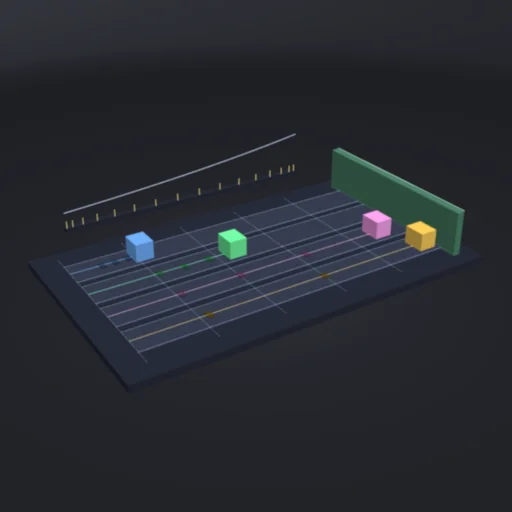
Accuracy is bought with work, and the exchange rate is not a property of the method. Four rules integrate the same function and the currency is how many times the function is read: the race is run on a chart of error against evaluations with a tolerance line you set, after you predict the winner. On a smooth function Gauss reaches machine precision in eight readings where the trapezoid rule needs sixty-five thousand; put one kink in the function and every high-order rule collapses to the same crawl. And past ten million terms the additions themselves lose six digits.
What happens
Four ways to integrate a function, racing on one currency: evaluations of the function. On a smooth integrand the trapezoid rule gains two digits every time the step halves, Simpson four, Romberg more with every level, and Gauss wins outright - eight points to fifteen digits. Put a kink in the integrand and the race collapses: every rule crawls at the trapezoid's pace and Gauss, which assumes smoothness, never gets there. Make it wiggly and the order flips again. Try the three integrands and watch who reaches 1e-10 first and at what cost.
Equations used in the module
Equations
trapezoid: error ~ h², Simpson ~ h⁴, Romberg ~ h^{2k}, Gauss ~ e^{−cn} (smooth f)
cost = evaluations of f, not steps
e^x on [0,1], 9 evaluations: 2e−3 / 2e−6 / 3e−10 / 1e−15
|x − 0.4|: every rule ~ h², Gauss no better