MakarovSuites
English
EnglishDeutschРусскийУкраїнськаFrançaisEspañolItalianoPolski
Contact & licences

Earth

Tsunami reaches the shore

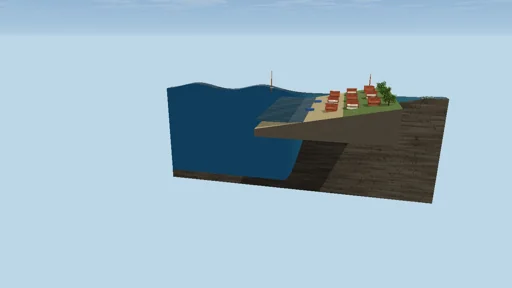
Raise a hump of sea three metres high over deep water and watch it split and run: the crest crosses the deep ocean at sqrt(g h), close to two hundred metres a second, reaches the tide gauge exactly when the closed form says, slows and grows over the continental shelf, and runs up the beach among the houses of a fishing village. A steeper beach floods less far inland; close the coast into a bay and the wave funnels to twice the run-up. The scheme keeps a sea at rest at rest over any bed, never lets a depth go negative, and accounts for every cubic metre that crosses the open-sea boundary.
Tsunami reaches the shore — Actual application image
Actual application image

What happens

The nonlinear shallow-water equations along a 60 km strip in 1200 cells: 2000 m of ocean, a slope to a 100 m shelf, a 1:50 beach up to land 20 m high, the width optionally narrowing fivefold into a bay. Faces use Audusse’s hydrostatic reconstruction with the HLL flux, so a lake at rest stays at rest over any bed, dry land included, and depths stay positive; Manning friction is implicit; the step follows a Courant number of 0.45. A Gaussian hump 3 m high and 5 km wide is the given start - the rupture that raised it is not computed. The run-up is the waterline’s height, the volume balance includes what leaves through the open sea.

Try this

Compare the arrival at the deep gauge with the closed-form long-wave time; watch the wave grow on the shelf; flood the village; make the beach steeper; close the coast into a bay.

The model and its limits

One horizontal dimension, no dispersion, no breaking model beyond the shock-capturing scheme, a smooth given source, houses that do not affect the flow. This teaching coast is not a hazard map.

Equations used in the module
Equations
∂(b·h)/∂t + ∂(b·h·u)/∂x = 0
∂(b·h·u)/∂t + ∂(b·(h·u² + g·h²/2))/∂x = g·h²/2·∂b/∂x − g·b·h·∂z/∂x − friction
h* = max(0, h + z − max(z_L, z_R)),  HLL flux
c = √(g·h),  A2/A1 = (h1/h2)^(1/4)·(b1/b2)^(1/2)  (Green)
Related experiments

Back to catalogue
Wind builds dunes — Actual application image

Earth

Wind builds dunes

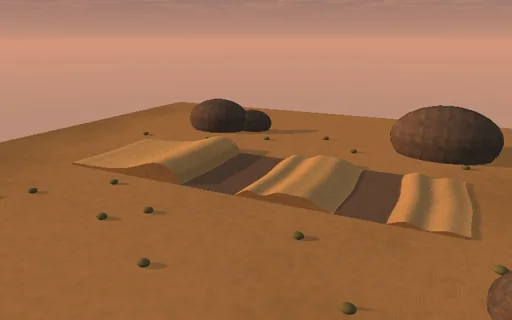
Blow wind over a strip of desert sand in the evening light. The shear on the bed peaks a little upwind of every crest, the sand flux takes a saturation length to catch up with it, the flow separates behind each crest and the slip face avalanches at the angle of repose - so a small ripple on a flat sheet grows at exactly the rate the linear theory gives, and two dunes walk downwind at about the Bagnold speed q/H, blowing the sheet between them down to the rock. Calm the wind below the threshold and nothing moves; wet the sand to raise it; let the wind reverse for part of the year and the dunes stop marching; put a stone wall across the wind. The periodic strip keeps every grain.

Global atmospheric circulation — Actual application image

Earth

Global atmospheric circulation

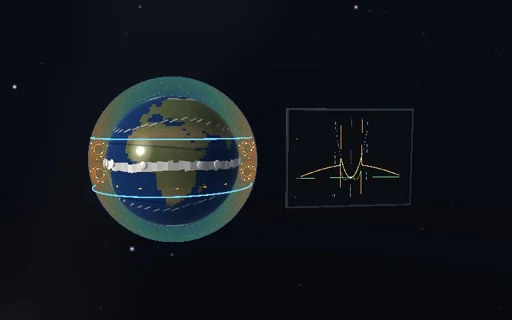
Spin up a planet’s atmosphere from rest and watch the Hadley cells grow out of the tropics until Held and Hou’s closed form says they must stop: air rising at the equator keeps its angular momentum on the way poleward, so the upper wind becomes Ω·a·sin²φ/cos φ, a subtropical jet, and the cell reaches only as far as the equal-area construction allows - 26.5° for the Earth, not the 28.8° of the small-angle formula. Beneath it the trade winds turn to westerlies where the angular-momentum budget says, and their torques cancel. Slow the planet and the cells widen towards the poles; stop it and one cell fills each hemisphere with no zonal wind at all. Move the heating six degrees north and the ascent jumps to 21°, the winter cell a hundred times stronger than the summer one, as Lindzen and Hou found; let the seasons run and the ITCZ swings 18° each way, two months late.

Sea and land breezes — Actual application image

Earth

Sea and land breezes

Land warms and cools faster than water. Follow the circulation and switch between day and night.