MakarovSuites
English
EnglishDeutschРусскийУкраїнськаFrançaisEspañolItalianoPolski
Contact & licences

Earth

Wind builds dunes

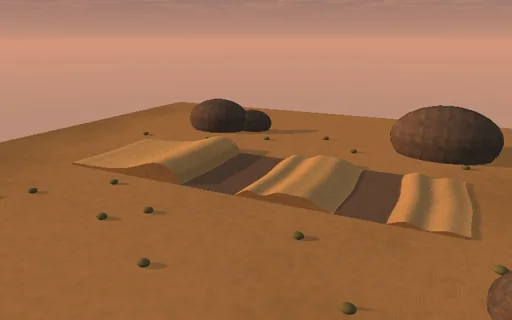
Blow wind over a strip of desert sand in the evening light. The shear on the bed peaks a little upwind of every crest, the sand flux takes a saturation length to catch up with it, the flow separates behind each crest and the slip face avalanches at the angle of repose - so a small ripple on a flat sheet grows at exactly the rate the linear theory gives, and two dunes walk downwind at about the Bagnold speed q/H, blowing the sheet between them down to the rock. Calm the wind below the threshold and nothing moves; wet the sand to raise it; let the wind reverse for part of the year and the dunes stop marching; put a stone wall across the wind. The periodic strip keeps every grain.
Wind builds dunes — Actual application image
Actual application image

What happens

A periodic strip of sand 256 m long in 512 cells. The bed shear is tau0 (1 + F^-1[(A|k| + iBk) h^]) with A = 3.2 and B = 0.3 over the envelope of the bed, each separation bubble filled to its 14° shadow line and the shear zero inside it. The saturated flux grows with the excess shear above the threshold (a tenth of sqrt(rho_s g d/rho), raised by moisture), the flux relaxes to it over 0.5 m exactly cell by cell and closed around the period, and never takes more than a cell holds above the rock. The bed follows Exner’s balance; slopes above 34° avalanche. Explicit steps of a thousandth of a year; one second is a year at time scale 1.

Try this

Grow dunes from a rippled sheet and compare the growth with the linear theory; watch two dunes walk; calm the wind below the threshold; wet the sand; let the wind reverse; put up the fence.

The model and its limits

A one-dimensional strip, a linear shear kernel with a geometric shadow line, a single grain size, no vegetation or crust. Rates are those of this idealized dune field.

Equations used in the module
Equations
τ = τ0·(1 + IFFT[(A|k| + iBk)·FFT h]),  τ = 0 in the separation bubble
q_s = Q·(τ/τ0 − r)/(1 − r),  r = (u*_t/u*)²
l_s·dq/dx = q_s − q,  ∂h/∂t = −∂q/∂x,  slopes ≤ 34°
σ(k) = Q·k²·(B − A·k·l_s)/((1 + (k·l_s)²)·(1 − r)),  c ≈ q_crest/H


Related experiments

Back to catalogue
Global atmospheric circulation — Actual application image

Earth

Global atmospheric circulation

Spin up a planet’s atmosphere from rest and watch the Hadley cells grow out of the tropics until Held and Hou’s closed form says they must stop: air rising at the equator keeps its angular momentum on the way poleward, so the upper wind becomes Ω·a·sin²φ/cos φ, a subtropical jet, and the cell reaches only as far as the equal-area construction allows - 26.5° for the Earth, not the 28.8° of the small-angle formula. Beneath it the trade winds turn to westerlies where the angular-momentum budget says, and their torques cancel. Slow the planet and the cells widen towards the poles; stop it and one cell fills each hemisphere with no zonal wind at all. Move the heating six degrees north and the ascent jumps to 21°, the winter cell a hundred times stronger than the summer one, as Lindzen and Hou found; let the seasons run and the ITCZ swings 18° each way, two months late.

Sea and land breezes — Actual application image

Earth

Sea and land breezes

Land warms and cools faster than water. Follow the circulation and switch between day and night.

Seasonal monsoon — Actual application image

Earth

Seasonal monsoon

Follow a South-Asian coast through the year. The same sun heats the shallow land and the deep sea, but the land answers within days and the sea two months late, as the closed-form gain 1/sqrt(1+(ωτ)²) and lag atan(ωτ) say. Their contrast drives an overturning wind; onshore it brings the sea air’s moisture, and the rain’s latent heat strengthens the very circulation that brought it. So the monsoon does not grow gently: once the land’s forcing turns positive the rain jumps to a deluge within a week, dark clouds roll in from the sea and pile against the hills, the paddies flood and turn green; it holds on into the autumn until the forcing falls below the fold R_c = −M²/(4Dκ). Hold the season and the coast is bistable: a moist surge flips it wet, lowering the heating or the moisture past the closed-form threshold dries it for good. The moisture budget closes to round-off.