Earth
Global atmospheric circulation
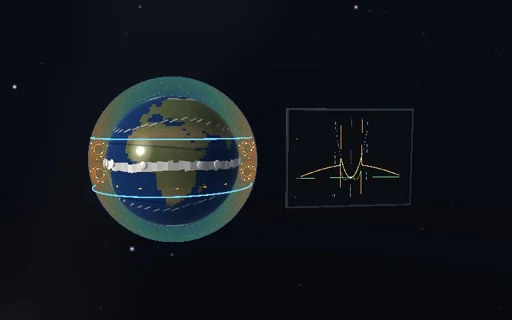
Spin up a planet’s atmosphere from rest and watch the Hadley cells grow out of the tropics until Held and Hou’s closed form says they must stop: air rising at the equator keeps its angular momentum on the way poleward, so the upper wind becomes Ω·a·sin²φ/cos φ, a subtropical jet, and the cell reaches only as far as the equal-area construction allows - 26.5° for the Earth, not the 28.8° of the small-angle formula. Beneath it the trade winds turn to westerlies where the angular-momentum budget says, and their torques cancel. Slow the planet and the cells widen towards the poles; stop it and one cell fills each hemisphere with no zonal wind at all. Move the heating six degrees north and the ascent jumps to 21°, the winter cell a hundred times stronger than the summer one, as Lindzen and Hou found; let the seasons run and the ITCZ swings 18° each way, two months late.
What happens
The column potential temperature θ of 120 bands of equal area in x = sin φ relaxes in τ = 20 days to the radiative equilibrium θ_E = θ0 − Δθ((x − x_h)² − 1/3), θ0 = 300 K, Δθ = 100 K, starting isothermal. The overturning carries heat away from the ascent x0 by Hide’s theorem: where the temperature gradient is steeper than the one in balance with the angular-momentum-conserving wind u_M = Ω·a·(x² − x0²)/cos φ, the cell carries the flux F = D·(G − G_M) with D = 5 per day, which holds θ on θ_M = θ_M0 − K·(x² − x0²)²/(1 − x²), K = θ0·Ω²a²/(2gH) = 330 K for H = 10 km. Backward Euler at six-hour steps, the cell’s extent iterated within each step; the ascent follows the warmest column in ten days. The heat content changes exactly by the heating. The upper wind is u_M in the cell and the gradient wind of θ outside; a two-layer column with ΔV = 20 K gives the mass streamfunction Ψ = 2πa²(p_s/g)·F/ΔV; the surface wind closes the lower layer’s angular-momentum budget with a friction time of 2 days, so the torques of trades and westerlies cancel. The closed forms: the small-angle edge √(5gHΔθ/(3Ω²a²θ0)) = 28.8°, the exact equal-area edge 26.5°, the Lindzen-Hou cells for an offset heating, the steady surface wind and its turn at 17.2° (√(3/7) of the cell in the small-angle limit).
Try this
Watch the cells spread from the equator and stop at the closed-form edge; compare the jet with Ω·a·sin²φ/cos φ and the turn of the surface wind; slow the rotation to a tenth and to nothing; halve the heating contrast; move the heating off the equator, then let the seasons run.
The model and its limits
Zonally symmetric: a Held-Hou relaxation model with a fixed static stability and depth, Newtonian heating, no moisture, no eddies and no ocean. The upper flow is taken as angular-momentum conserving inside the cell; the surface wind is diagnosed from the steady angular-momentum budget of the lower layer, so it is weak, as in the theory. The Ferrel and polar cells, the storm tracks and the cloud belts are drawn as a schematic: eddies drive them and the model has none. Edges agree with the closed forms to about a band, coarser near the poles. Not to scale: the atmosphere is drawn some thirty times too thick.
Equations used in the module
Equations
dθ/dt = (θ_E − θ)/τ − ∂F/∂x,  θ_E = θ0 − Δθ·((x − x_h)² − 1/3),  x = sin φ
F = D·(G − G_M) where (x − x0)·(G − G_M) > 0,  G = −∂θ/∂x,  θ_M = θ_M0 − K·(x² − x0²)²/(1 − x²),  K = θ0·Ω²a²/(2gH)
u_M = Ω·a·(x² − x0²)/cos φ,  Ψ = 2πa²·(p_s/g)·F/ΔV,  u_s = −(2τ_f/(ΔV·cos φ))·∂(F·cos φ·u_M)/∂x
φ_H ≈ √(5gHΔθ/(3Ω²a²θ0)),  exact: −(2/3)·Δθ·X³ + K·(X⁵/(1 − X²) + X + X³/3 − atanh X) = 0