Engineering
Typewriter and mechanical timing
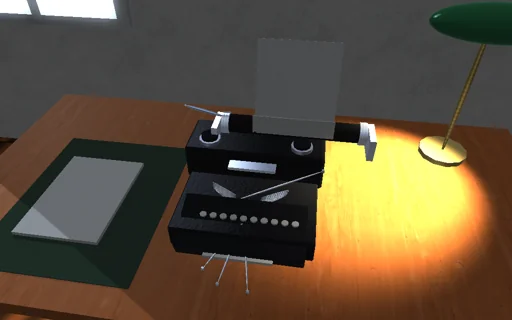
Type at an office desk by the window: a press drives the key and its typebar through the linkage as one body against the return spring; when the key bottoms the bar flies on alone and strikes the platen with exactly the energy the closed form gives, and what the ribbon does not return inks the letter. Press more softly than the threshold force and the bar never arrives; type faster and faster until two bars meet in the type guide and jam; load the carriage until it cannot step one letter pitch before the next strike, and the letters land on top of each other. The work of the fingers is booked against every loss.
What happens
Four typebars of 5·10⁻⁵ kg·m², each linked to its key at 100 rad per metre of key travel, against a return spring of 12 mN·m plus 8 mN·m per radian. While the key is down key and bar move as one body of effective mass m_k + I G²; when the key bottoms at 12 mm its own kinetic energy goes into the key stop and the bar flies on to the platen at 1.75 rad, strikes with restitution 0.2 and falls back to its rest pad. Each strike releases the escapement: the mainspring pulls the 2.5 kg carriage one pitch of 2.54 mm. Two bars above the type-guide angle at once jam. RK4 at 20 µs; the work of the fingers is booked against every loss.
Try this
Press one key and compare the strike energy with the closed form; type faster until the basket jams, then clear it; load the carriage until letters land on each other; press softer than the threshold force.
The model and its limits
Rigid bars and keys, a linear spring, instantaneous impacts, a constant mainspring, four bars in use; no ribbon feed or line spacing mechanics. Energies are those of this idealized action.
Equations used in the module
Equations
(m_k + I·G²)·a_x = F_key − G·(τ0 + k·θ),  θ = G·x
E_strike = (I·G²/m_eff)·(F·d − W_e) − W_free
E_ink = E_strike·(1 − e²),  F_min = (W_free·m_eff/(I·G²) + W_e)/d
t_c = √(2·m_c·p/(F_s − F_f)),  jam: two bars above θ_g